- 000 - 123 - 456789
- info@trustaclinic.ae
- VILA 17, Street 73B, AL SATWA, Dubai, UAE


CONTACT US
- (000) 123-456-789
- VILA 17, Street 73B, AL SATWA, Dubai, UAE.
- info@trustaclinic.ae
Knee Replacement Surgery in Dubai
Most people who finally come to see us did not arrive at that decision quickly. It crept up on them. A knee that ached after long walks. Then ached during short ones. Then started waking them up at night. Then came the quiet adjustments, avoiding certain chairs, skipping trips they used to enjoy, finding excuses not to climb stairs. By the time they sit across from us at Trusta Clinic, the knee has already been running their life for a while.
That is what we are here to change.
What Is Actually Going Wrong Inside Your Knee
Your knee works hard. Every step, every turn, every time you lower yourself into a seat, that joint is managing load across three bones held together by cartilage, ligaments, and muscle. Cartilage is the silent hero here. It is what keeps the bones from grinding against each other. When it wears away, and in arthritis it absolutely does, you are left with bone on bone. That is where the pain comes from. Not from a muscle. Not from inflammation you can easily treat. From a structural problem inside the joint itself.
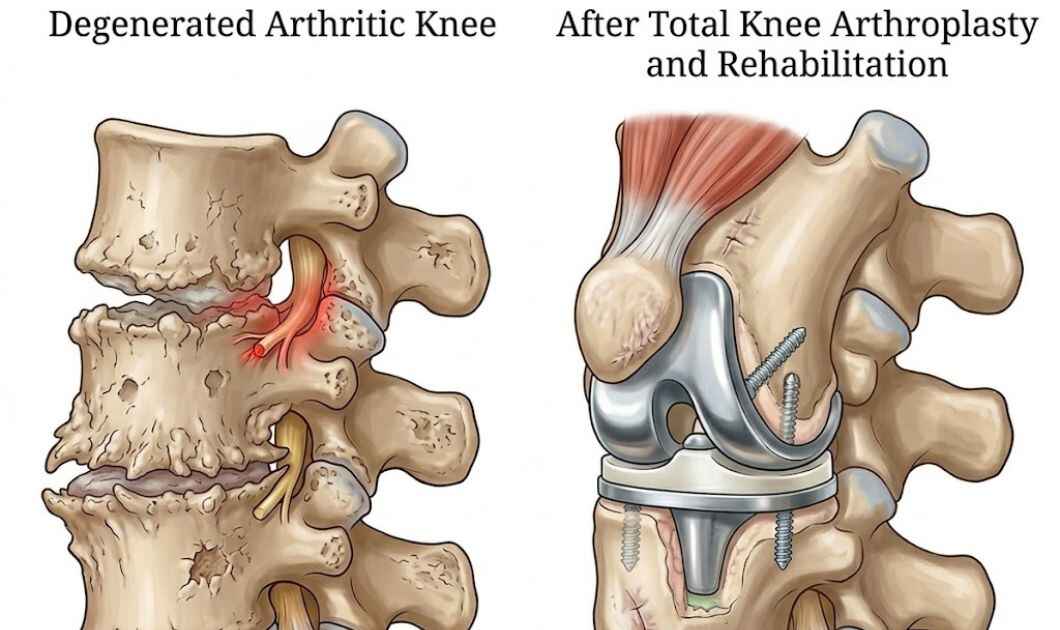
Knee replacement surgery, which doctors call knee arthroplasty, fixes this at the source. We remove the damaged bone and cartilage surfaces and replace them with an artificial knee joint built from medical-grade metal and a smooth plastic insert. The knee implant recreates what healthy cartilage used to do.
Movement becomes easier. The grinding stops. The pain, for most patients, goes with it.
Depending on how much of the joint is affected, we may recommend total knee replacement, which covers all three compartments, or a partial approach if only one area has deteriorated. Both are legitimate forms of knee arthroplasty. The right one depends entirely on your knee, not on a general preference.
Do You Actually Need Knee Surgery
Fair question. And the honest answer is: not everyone does, at least not yet.
We do not push patients toward knee joint replacement before they are ready or before it is genuinely warranted. A lot of people come to us having tried physiotherapy for months, tried injections that worked for a while then stopped, tried anti-inflammatory medications that helped less and less over time. When those options run dry, that is usually when the real conversation about knee surgery starts.
What we listen for in that conversation is simple. We want to know how much the knee has taken from you.
- Is the pain there most days, even on good days?
- Does it wake you up at night or stop you from sleeping well?
- Have you stopped doing things you used to do without thinking, walking a reasonable distance, getting up from a low seat, moving around a shop or a mall comfortably?
- Has physiotherapy genuinely plateaued with no further improvement?
- Do imaging scans confirm significant arthritis, whether from years of wear, rheumatoid disease, or an old injury?
- Is the knee visibly deformed, bowing inward or outward in a way it never used to?
If most of those feel familiar, knee replacement surgery is worth discussing seriously.
The Types of Knee Replacement We Offer
We do not have a standard package. Knee arthroplasty by Trusta Clinic is shaped around what your joint actually needs.
Total Knee Arthroplasty
This is the most commonly performed knee surgery we carry out. All three compartments of the joint are resurfaced, the ends of the thigh bone, the shin bone, and the underside of the kneecap. For patients with arthritis that has spread across the full joint, total knee replacement delivers the most complete and lasting relief. It is one of the most well-studied procedures in all of orthopedic surgery, with strong outcomes documented over decades.
Partial Knee Replacement
When damage has genuinely stayed in one compartment, we can limit the procedure to just that area. Less bone is removed. Recovery is typically faster. And many patients say the knee feels more natural afterward because more of the original joint is preserved.
Revision Knee Replacement
Some patients come to us after a previous knee replacement, performed elsewhere or years ago here, that has started to fail. Loosening, wear, infection, or simply age can compromise an implant over time. Revision surgery is more complex than a first procedure and our surgeons approach it with the level of care that complexity demands.
What Happens During the Knee Replacement Procedure
We go through this in detail with every patient before their surgery date. Knowing exactly what is happening makes a real difference to how people feel going in.
Before Surgery
We start with thorough imaging, bloodwork, a medication review, and a one-on-one consultation where we build the surgical plan specific to your anatomy. Nothing is copied from a template.
On the Day
You will receive either general anesthesia or a spinal block. Our anesthesiologist makes that call with you based on your health profile. Once settled, our surgeon accesses the knee through an incision at the front of the joint. The damaged cartilage and bone are removed and the remaining bone shaped carefully to accept the new components. The artificial knee joint is then seated and secured, with the plastic spacer placed between the metal parts to allow smooth, controlled movement. The incision is closed in layers and dressed.
Start to finish, the knee replacement procedure runs between one and two hours. Most patients are back in their room and taking their first assisted steps the same day or the morning after.

Before

After
Recovery: The Honest Version
Recovery from knee replacement surgery is not something that just happens to you. It takes real effort, especially in the first few weeks. But the progress is visible and most patients find that motivating in itself.
Week 1
You will be moving within 24 hours. Assisted, carefully, but moving. Early mobilization is one of the strongest predictors of a good outcome and our physiotherapy team starts working with you immediately.
Weeks 2 to 6
Most patients go home within two to four days. At home the work continues, daily exercises, gradually increasing walking distance, managing swelling, attending follow-up appointments with us. By week six most people are managing their daily routine with real confidence.
Months 2 to 6
Driving typically returns around six to eight weeks. Strength and range of motion keep building steadily. The full benefit of total knee arthroplasty tends to become clear somewhere between three and six months after surgery, when the joint has settled and the surrounding muscle has properly rebuilt.
We stay in contact throughout. Recovery from knee surgery does not end at discharge.
Why Patients Come to Us
There are good orthopedic options in Dubai. We know that. What we hear most consistently from patients who chose us for their knee joint replacement is that they felt genuinely heard here. Not processed. Not rushed toward a surgical date. Actually listened to.
Clinically, our surgeons carry deep experience in total knee replacement and the full range of knee arthroplasty procedures. We use certified, high-performance knee implants and work with robotic-assisted surgical technology that improves the accuracy of component placement in ways that directly affect how the knee performs and how long the implant lasts.
Beyond that:
- Consultations are never rushed
- Our team includes multilingual support for patients coming from across the UAE and the region
Pricing is transparent with no surprises - Post-operative care is structured and sustained, not handed off after discharge
- We treat the whole patient, managing any underlying conditions like diabetes or cardiovascular disease that could affect surgical outcomes
A Word on Risk
Knee replacement surgery has a strong safety record. But we will always give you the complete picture, because you are making a serious decision and you deserve full information.
Possible complications include infection, blood clots, stiffness during recovery, and in rarer cases issues with the knee implant over the longer term. We take active precautions at every stage, carefully managed anticoagulation, early movement, close monitoring after discharge. Your surgeon will walk through all of this with you personally before any decision is made.
