


Chemical peel types – at a glance
As part of your training, you study three primary peel types in depth. The table below summarises the key differences between them:
Peel type | Main ingredient | Depth | Best for | Downtime |
AHA Peel | Glycolic / Lactic acid | Superficial | Dull skin, mild pigmentation, fine lines | Minimal (0–2 days) |
BHA Peel | Salicylic acid | Superficial to medium | Acne, oily skin, clogged pores | Low (1–3 days) |
TCA Peel | Trichloroacetic acid | Medium to deep | Hyperpigmentation, wrinkles, acne scars | Moderate (3–7 days) |
Who should attend this course?
Trusta Academy designed this course for practitioners at every stage of their aesthetic career. You do not need prior experience in chemical peels to enrol all the knowledge and skills you need are built within the programme itself.
This course is ideal for:
- Beauty therapists who want to add medically credible, high-demand treatments to their service menu
- Nurses and healthcare professionals seeking a structured route into aesthetic practice
- Doctors expanding into cosmetic dermatology and non-surgical skin treatments
- Estheticians and skincare specialists who want to deepen their clinical knowledge and refine their technique
- Career changers with a strong interest in skin science and professional aesthetics
The only formal entry requirement is completion of secondary education (Grade 12 or equivalent). Everything else, you build here.
Real client results – what trained practitioners achieve
The outcomes described below represent results achieved by qualified aesthetic practitioners using the exact techniques and protocols you will learn in this course. Each case illustrates a different skin concern, peel type, and client profile reflecting the range of real-world scenarios you will be fully prepared to handle after certification.
Skin concern | Peel used | Client profile | Sessions | Outcome |
Uneven tone & dullness | AHA – Glycolic 30% | Fitzpatrick Type III, female, 34 | 3 sessions, 3 weeks apart | Visibly brighter, more even tone |
Active acne & clogged pores | BHA – Salicylic 20% | Fitzpatrick Type IV, male, 28 | 4 sessions, 2 weeks apart | Reduced breakouts, refined pores |
Deep pigmentation & acne scars | TCA Peel – 15% | Fitzpatrick Type III, female, 42 | 2 sessions, 6 weeks apart | Significantly reduced scarring & pigmentation |
Sun-induced melasma | Lactic acid 40% | Fitzpatrick Type V, female, 38 | 5 sessions, 3 weeks apart | Lightened melasma, improved clarity |
What the practical sessions at Trusta Academy prepare you to achieve
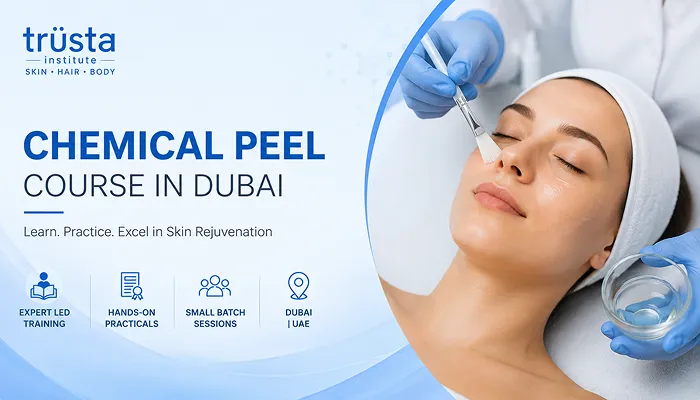
During your one-day intensive, you work with live models under full clinical supervision. This hands-on exposure means you leave the course having already performed a complete client consultation, selected the appropriate peel formulation, applied it safely, managed neutralisation, and delivered post-treatment advice all inside a professionally equipped treatment room. As a result, you build genuine clinical confidence before you treat a single paying client.
Core training modules in depth
AHA, BHA and TCA peels understanding the science behind each
Trusta Academy gives you a thorough understanding of the three main types of chemical exfoliants used by professionals today. Alpha Hydroxy Acids such as glycolic and lactic acid work on the skin’s surface and excel at improving texture and mild hyperpigmentation because of their water-soluble nature. Beta Hydroxy Acids, particularly salicylic acid, penetrate deeper into pores thanks to their oil-soluble properties, making them the go-to choice for acne-prone and congested skin. Trichloroacetic Acid peels work at medium to deeper levels and address more significant signs of ageing, deeper pigmentation, and uneven skin texture. By the end of this module, you will confidently select the right peel, at the right concentration, for any client who sits in your chair.
Pre and post-treatment protocols
A chemical peel begins well before the product touches the skin and extends long after the session ends. With that in mind, our training covers exactly how to prepare the skin in the days leading up to treatment including pre-treatment product use, sun avoidance, and readiness assessment. Post-treatment care receives equal attention. Consequently, you learn how to support clients through the peeling and sensitivity phases, manage healing responses, and recommend homecare products that protect and extend results.
Safety and contraindications
Patient safety forms the foundation of every treatment you perform. This module teaches you to identify conditions that prevent or modify chemical peel treatments including active infections, autoimmune conditions, isotretinoin use, pregnancy, specific Fitzpatrick skin types, and history of keloid scarring. Additionally, you learn to recognise adverse reactions such as excessive redness, blistering, or post-inflammatory pigmentation, and to manage each one appropriately. Risk assessment and informed consent procedures are covered in full.
Professional application techniques
Our hands-on training section gives you direct experience applying chemical peels under full supervision. You cover correct preparation steps, safe and even product application, timing control, neutralisation technique, and how to adapt your approach based on zone sensitivity across the face. Because application technique directly determines both results and safety, our practical sessions build genuine skill and real confidence not just theoretical awareness.
Skin analysis and diagnosis
Effective chemical peel treatment starts with accurate skin assessment. This module teaches systematic skin analysis covering skin type identification, Fitzpatrick phototype classification, primary concern mapping, and contraindication screening all before you form a treatment plan. You learn to use consultation forms effectively, conduct visual and tactile assessments, and set realistic client expectations. Strong diagnostic skills protect your clients and raise the quality and consistency of every session you deliver.
Career outcomes and earning potential after this course
Completing your Chemical Peel Certification at Trusta Academy opens the door to one of the UAE’s fastest-growing industries. The aesthetic medicine market in Dubai alone is projected to exceed USD 1.3 billion by 2027, and qualified chemical peel practitioners are among the most sought-after professionals in clinics, medical spas, and wellness centres across the Emirates.
AED 5,500 Starting monthly salary | AED 12,000 Experienced practitioner / month | AED 400-800 Freelance earning per session | 500+ Clinics hiring in Dubai |
Job roles you can apply for immediately after certification
- Aesthetic therapist work in dermatology clinics and medical spas delivering AHA, BHA, and TCA treatments, typically on a base salary plus treatment commission
- Skincare specialist combine chemical peels with other treatments in five-star hotel spas, wellness centres, and luxury beauty clinics across the UAE and wider GCC
- Freelance aesthetician — set your own schedule and rates; established freelancers in Dubai routinely see 4–6 clients per day at AED 400–800 per session
- Aesthetic trainer progress into educator and training roles within beauty academies, a path that commands premium daily rates and offers long-term career stability
Your career progression path
Most practitioners follow a clear progression from the moment they certify. You begin as a junior aesthetic therapist, building your client base and refining your technique. As your confidence and case count grow, you advance to a senior skin specialist role. From there, you can move into a clinic lead or head therapist position or choose to launch your own independent practice. Many Trusta Academy graduates establish their own clinic-based or mobile aesthetics business within 12–18 months of certifying.
Chemical peels for darker skin tones – what every UAE practitioner must know
Dubai’s client population is predominantly South Asian, Arab, East African, and Southeast Asian skin tones that fall across Fitzpatrick Types III to VI. This is where undertrained practitioners make avoidable and sometimes severe mistakes. A glycolic peel concentration that is perfectly safe for Fitzpatrick Type II can trigger post-inflammatory hyperpigmentation (PIH) in a Type V client, leaving the skin noticeably darker than before treatment.
Trusta Academy addresses this directly. Understanding how to adapt peel selection, concentration, and contact time for darker skin tones is a core competency you take away from this course not an optional add-on. It is essential knowledge for every practitioner working in the UAE market.
Fitzpatrick skin typing and peel suitability – reference guide
Type | Skin description | Recommended peel | PIH risk | Key precaution |
Type I–II | Very fair, burns easily | AHA, BHA, TCA up to 25% | Low | Standard protocols apply |
Type III | Medium, sometimes burns | AHA (lactic), BHA, TCA 10–15% | Low–Med | Pre-prime with retinoid 2 weeks before treatment |
Type IV | Olive to light brown | Lactic acid, mandelic acid, low BHA | Medium | Avoid high-% glycolic; patch test mandatory before first treatment |
Type V | Brown skin, rarely burns | Mandelic acid, low lactic, kojic acid | High | Pre-treat with hydroquinone for 4 weeks; strict SPF 50 post-treatment |
Type VI | Very dark, never burns | Mandelic acid only — superficial only | Very High | TCA is contraindicated; treat only under experienced clinical oversight |
Why mandelic acid is the preferred choice for darker skin types
Mandelic acid, an AHA derived from bitter almonds, has a larger molecular size than glycolic acid. As a result, it penetrates the skin more slowly and evenly, which significantly reduces the risk of triggering the inflammatory response that causes PIH in melanin-rich skin. For Fitzpatrick Types IV through VI, mandelic acid delivers reliable exfoliation, pigmentation reduction, and texture improvement without the risk profile of glycolic or TCA peels at standard concentrations. Our training covers mandelic acid protocols in detail, including starting concentrations, application timing, and how to assess the client’s skin response in real time.
The role of pre-treatment priming for darker skin clients
For Fitzpatrick Type IV and above, pre-treatment priming is not optional it is a fundamental part of responsible practice. Priming the skin 2–4 weeks before a peel reduces baseline melanocyte activity, which makes the treatment both safer and more predictable. As part of this course, you learn the following priming protocols, developed specifically for the UAE client demographic:
- Hydroquinone 2–4% cream applied nightly for 4 weeks prior to treatment
- Retinoid (tretinoin 0.025–0.05%) to normalise cell turnover and improve peel penetration
- SPF 50 broad-spectrum sunscreen as a daily requirement throughout priming and recovery
- Azelaic acid as an alternative to hydroquinone for pregnant or sensitive clients
- Vitamin C serum to stabilise melanocyte activity and support barrier function post-peel
Practical protocols you will learn for darker skin treatment
In addition to peel selection and priming, you learn four critical protocols for safer peel delivery on darker skin:
- Patch testing always perform a 48-hour patch test on the neck or behind the ear before full facial application on Type IV+ clients, without exception
- Reduced contact time for darker skin types, reduce standard contact times by 30–50%, monitoring the skin response continuously throughout the session
- Stepwise concentration begin at the lowest effective concentration and increase across sessions only once the client’s tolerance is confirmed in clinic
- Post-treatment sun protocol clients must avoid direct sun exposure for a minimum of 14 days post-peel and apply SPF 50 twice daily; non-compliance is the leading cause of PIH
Certification and accreditation
After successfully completing the Chemical Peel Course, you receive a Certified Chemical Peel Practitioner Certificate issued by Trusta Academy. This certificate is recognised across the UAE aesthetic and medical beauty industry and accepted by aesthetic clinics, dermatology centres, medical spas, and wellness facilities throughout the Emirates.
Your certification confirms competency in the following areas:
- AHA, BHA, and TCA peel application
- Safe client consultation and contraindication assessment
- Pre and post-treatment protocol management
- Adverse reaction recognition and appropriate clinical response
Importantly, Trusta Academy’s training standards align with Dubai Health Authority (DHA) guidelines for aesthetic practice. If you plan to work in a DHA-licensed facility, we recommend confirming any additional individual licensing requirements directly with the DHA, as these vary by role and treatment category.
Course fees and schedule
Detail | Information |
Duration | 1 full day (intensive format) |
Location | Villa 17, Sheikh Zayed Road, Downtown Dubai, UAE |
Class size | Intentionally small to guarantee hands-on time for every participant |
Fee range | AED 1,500 – AED 4,000 (exact fee confirmed at enrolment consultation) |
Payment options | Flexible instalment plans available through Tabby and Tamara — spread the cost with no interest |
The course fee includes full-day classroom and practical training, hands-on sessions with live models, a professional peel kit and all course materials, your Certified Chemical Peel Practitioner Certificate, and ongoing post-course support from the Trusta Academy team.
Why train with Trusta Academy?
Trusta Academy is a dedicated aesthetic training institute built for practitioners who take professional development seriously. Our courses are delivered by experienced clinical educators who bring real-world practice into every session. Because we keep class sizes intentionally small, you receive individual guidance and sufficient hands-on experience not just a seat in a lecture theatre.
Our academy operates from Sheikh Zayed Road, one of Dubai’s most accessible locations, making travel straightforward from across the city and wider UAE. Furthermore, our training environment reflects a real clinical setting, equipped with professional tools and materials used daily in aesthetic practice.
Most importantly, training with Trusta Academy goes beyond earning a certificate. We focus on building the practical skills, clinical understanding, and professional credibility you need to progress confidently and immediately within the aesthetics industry.
