
Occupational Therapy for Everyday Independence
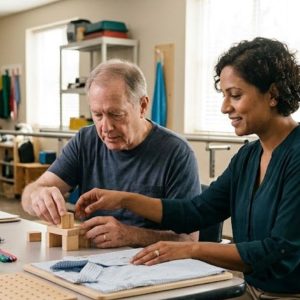
Trusta Medical Center provides occupational therapy focused on the tasks you need to manage every day. Our Occupational Therapist helps patients regain independence, improve hand and motor function, and return to daily activities after injury, illness, or surgery.
Our DHA-licensed occupational therapists work with children, adults, and older adults. We provide therapy from our clinic in Downtown Dubai with care focused on practical skills, movement, and everyday independence.
People come to us after strokes, hand injuries and operations. Parents bring children who struggle with handwriting, sensory overload or coordination.
Whether the cause is a stroke, a hand injury, a developmental delay, or the slow effects of aging, treatment focuses on one goal: helping you do the things that matter to you again. Every program at Trusta Medical Center centers on your actual routine, not a generic recovery template.

Why Do Patients Choose Our Clinic for This Therapy?
Every therapist on the team holds DHA registration and a recognised occupational therapy qualification. We treat all ages under one roof, which matters more than it sounds. A family stops driving one child to sensory sessions on one side of Dubai and a recovering father to hand therapy on the other.
Sessions run one to one, every time. Nobody shares their therapist with the patient on the next mat. What people mention most, though, is the questions we ask. We want to know what your Tuesday looks like, not only what your scan shows.

What Does an Occupational Therapist Do?
We find out which everyday activities have become difficult, agree on what you want back, then train those tasks until they hold up in real life. If you want the textbook version, occupational therapy is the practice of helping people take part in the everyday activities they need or want to do.
The goals patients bring us usually sound small: getting dressed without waiting for help, keeping several medications straight, doing the weekly grocery run alone, driving again or managing the metro, or using a phone or laptop when the hands have stopped cooperating.
Nobody thinks about these tasks until they disappear. Once they do, they quietly decide whether you live in your home or get looked after in it.
Occupational Therapy for Children
School asks a lot of small hands and developing nervous systems. Forming letters, opening a lunchbox, sitting through a lesson, tuning out the noise of twenty-five other children. When those skills lag behind, the frustration tends to show up as behaviour before anyone works out the cause. We treat children with autism spectrum disorder, ADHD, developmental coordination disorder, cerebral palsy, sensory processing difficulties and fine motor delays. Where a child also needs behaviour therapy, the two teams work off the same plan.
Parents often ask whether to wait for a formal diagnosis first. We tell them no. Early support does more, and we assess children without a diagnosis in hand.
Occupational Therapy for Older Adults
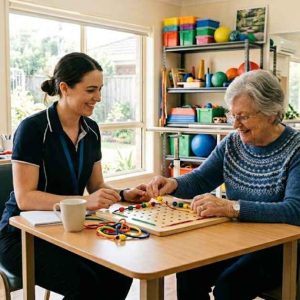
When daily tasks start slipping for an older patient, confidence usually falls faster than physical strength. That matters clinically, because it speeds up the decline everyone is working to slow.
So we start by asking what you want to keep doing. Cooking your own food. Showering safely. Managing your own medication. Then we work backwards, building the skills and safety strategies that keep those things yours.
Conditions We Treat
We help with any injury, condition or disability that makes daily life harder to manage. If yours is not listed, ask anyway. We will give you a straight answer and point you elsewhere if occupational therapy is not what you need.
Injury and Trauma Recovery
On the injury and trauma side, that covers bone fractures, burns, carpal tunnel syndrome, stroke, amputation, traumatic brain injury, spinal cord injury, and hand injuries including tendon repairs and nerve damage.
Chronic Conditions
Among chronic conditions, we treat multiple sclerosis, cerebral palsy, Parkinson’s disease, dementia and cognitive decline, rheumatoid arthritis and osteoarthritis of the hand and upper limb, and the anxiety, depression and burnout that wear down daily function.
Developmental and Neurological Conditions
On the developmental and neurological side, that includes autism spectrum disorder, ADHD across all ages, developmental coordination disorder and developmental delays.
Post-Surgical Rehabilitation
After surgery, we handle rehabilitation following joint replacement in the shoulder, elbow, wrist or hand, spine or head surgery, abdominal surgery, and amputation.
Occupational Therapist vs Physiotherapist
People mix these two up constantly, and the overlap is real. A physiotherapist gets the shoulder moving again. We make sure you can use that shoulder to reach a high shelf, fasten a seatbelt or lift a grandchild.
Physio deals in movement, strength and pain. We deal in the tasks that movement exists for. Plenty of our patients see both, and when that happens we coordinate the two plans so progress in one carries into the other.
How Our Occupational Therapy Assessment Works
It starts with a consultation. We go through your medical history, but the more useful conversation is about ordinary life, what became awkward and what you quietly stopped attempting. From there we move to functional observation, watching how you move and how your coordination holds up during a real task rather than an isolated exercise. For children, that includes how they react to sound, texture and movement.
Then we set goals, clear and measurable ones drawn from your priorities. If a goal is unrealistic, we say so now rather than six weeks in. Treatment follows, one to one, on the skills your goals depend on and practised in ways that transfer to home, school or work. We reassess at set points along the way and change the programme when something stops working.
Our Occupational Therapy Treatments
No two programmes look the same, so what a session involves depends on your case. It may draw on:
- Functional retraining, rebuilding a task by practising the task itself in stages until it becomes reliable
- Cognitive rehabilitation, using memory strategies and structured exercises after stroke or brain injury, and in dementia care
- Sensory integration therapy, helping children handle sound, texture and movement so school stops being a daily fight
- Hand and upper limb therapy, combining manual treatment, splinting and task-based retraining for injuries, carpal tunnel and arthritis
- Home and workplace assessments, looking at the actual room rather than a description of it
- Vocational rehabilitation, preparing you for a return to work that will genuinely hold
Recovery is rarely tidy. Some weeks move quickly and others stall. That is normal, and we plan for it.
Occupational Therapy for School-Age Children
A large share of our paediatric enquiries land within days of a hard parent-teacher meeting. Handwriting nobody can read. A child who cannot stay seated. Meltdowns in a noisy classroom.
Alongside treatment, we write reports schools can actually use. Detailed enough for a school to put real accommodations in place, which is what carries progress out of the clinic and into the classroom.
Start Occupational Therapy
You do not need a referral, a diagnosis or a tidy list of questions ready before you call. Tell us what has changed. We will listen, assess honestly and build a programme around your goals. If occupational therapy is not the right fit, we will say so and point you towards the support that is.
our expert answers
Frequently Asked Questions
How is an occupational therapist different from a physiotherapist?
An occupational therapist focuses on your ability to manage daily activities, while a physiotherapist focuses on physical movement and pain. Both professions frequently collaborate on the same client at Trusta Medical Center.
Do I need a referral to see an occupational therapist?
Usually not. Most clients contact Trusta Medical Center directly to book an assessment. If your insurer requires a referral, the clinic can guide you through what's needed.
Is occupational therapy covered by insurance in Dubai?
Many UAE health insurance plans include coverage for occupational therapy. It's worth confirming with your insurer beforehand, and Trusta Medical Center assists with pre-authorization paperwork when required.
How long does occupational therapy treatment take?
Duration depends on the individual and their goals. Some clients reach their goals in six to eight sessions, while others follow a longer rehabilitation plan. Realistic timelines are discussed at the first appointment and reviewed regularly.
Can occupational therapy help my child at school?
Yes. This is one of the most common reasons families contact Trusta Medical Center's occupational therapist team. Assessments and treatment are paired with detailed reports that schools can use to put real accommodations in place.

 Posted on Google
 amitisful
Trustindex verifies that the original source of the review is Google.
Amazing experience! The staff were wonderful and I’m very happy with the results. I’ll definitely come backThis is truly a state-of-the-art beauty clinic. The facilities, technology, and range of services available here are exceptional, and you won’t easily find the same level of comprehensive care in other clinics. As a physician, I highly recommend visiting this clinic. It is truly in a class of its own when it comes to aesthetic medicine, offering a complete range of beauty and aesthetic services, from surgical to non-surgical treatments, all under one roof..❤️❤️❤️Posted on Google Helmi Emadما شاء الله موقع ممتاز عيادة نظيفة تحسهم من المستقبل أما الاستقبال مررررة أدب تستأنث وياهم الصراحة ما تحس نفسك في عيادة من شدة إهتمام الدكاترة وباقي التيم كله متوفر عندهم مواقف سيارات مجانية ومصعد لذوي الاحتياجات الخاصة أشكر أصدقائي على التوصية بي عيادة ترستا واتمنى لكم التوفيق والنجاحPosted on Google
 Sahar GeramiPosted on Google
 Donna AskariAmazing clinicPosted on Google
 Farnaz Saeedi⭐⭐⭐⭐⭐ I had a great experience at Trusta Clinic. The staff were very professional, friendly, and welcoming. The clinic is clean, modern, and well-organized, and I really appreciated the attention to detail and the quality of service. Highly recommended! I’ll definitely be coming back. ❤️Posted on Google
 Layth SalhabAbsolutely amazing experience at Trusta Medical Center! ⭐️⭐️⭐️⭐️⭐️ The clinic is beautiful, modern, and very clean. The team is professional, welcoming, and genuinely attentive from the moment you arrive. You can really feel the high standard of care and attention to detail. Highly recommended for anyone looking for quality medical and aesthetic services in Dubai. 👌🏻✨Posted on Google
 sahra rezvanpanah⭐⭐⭐⭐⭐ I had a wonderful experience at Trusta Clinic, from the initial consultation all the way through my cosmetic procedure. Everyone, from the staff to the doctors, was incredibly supportive, caring, and attentive throughout the entire process. I truly felt that I was surrounded by people who genuinely cared about me, almost as if I were among friends. I’m very happy with my experience and would definitely recommend Trusta Clinic to anyone considering a cosmetic procedure.Posted on Google
 Mohammed AbdalraheemA lovely experience at Trusta Medical Center. The staff are kind, welcoming, and very professional, and the clinic has a clean and comfortable atmosphere. I truly appreciated the attention to detail, the respectful way everything was explained, and the high standard of care. The doctors are carefully selected and clearly experienced in their fields. A very pleasant and trustworthy medical center that I would happily recommend to others.Posted on Google
 Isis Aamn💖💖🌹 I had a very pleasant experience at Trusta Medical Center. The clinic is clean, elegant, and well organized, and the staff were welcoming and professional from the moment I arrived. I was especially impressed with the aesthetic medicine services. The doctors are highly professional, attentive, and take time to explain everything clearly. The prices are also reasonable and transparent. A very comfortable and trustworthy medical center. Highly recommended!🌹💖Posted on Google
 Ayden⭐⭐⭐⭐⭐ I had a wonderful experience at Trusta Medical Center. From the moment I arrived, the reception team was welcoming, professional, and very well organized. The entire clinic has a clean, elegant, and comfortable atmosphere, which immediately gives you a sense of confidence and trust. I was particularly impressed by their Aesthetic Medicine Department. The team takes the time to understand each patient’s concerns and expectations, and everything is explained clearly before making any decision. Their approach feels professional and patient-centered rather than commercial. The clinic also seems very selective in choosing its doctors. The medical team is experienced, knowledgeable, and genuinely focused on achieving natural and appropriate results while maintaining high standards of safety. Another positive point was the transparency regarding prices and treatment options. Everything was explained clearly, with no unnecessary pressure to undergo additional procedures. Overall, Trusta Medical Center is an excellent polyclinic that combines professional medical care, hospitality, cleanliness, fair pricing, and highly qualified doctors under one roof. I would confidently recommend it to anyone looking for a reliable medical center in Dubai, especially for aesthetic medicine. A truly five-star experience. Highly recommended. ❤️Verified by TrustindexTrustindex verified badge is the Universal Symbol of Trust. Only the greatest companies can get the verified badge who has a review score above 4.5, based on customer reviews over the past 12 months. Read more