- 000 - 123 - 456789
- info@trustaclinic.ae
- VILA 17, Street 73B, AL SATWA, Dubai, UAE


CONTACT US
- (000) 123-456-789
- VILA 17, Street 73B, AL SATWA, Dubai, UAE.
- info@trustaclinic.ae
Occupational Therapist in Dubai
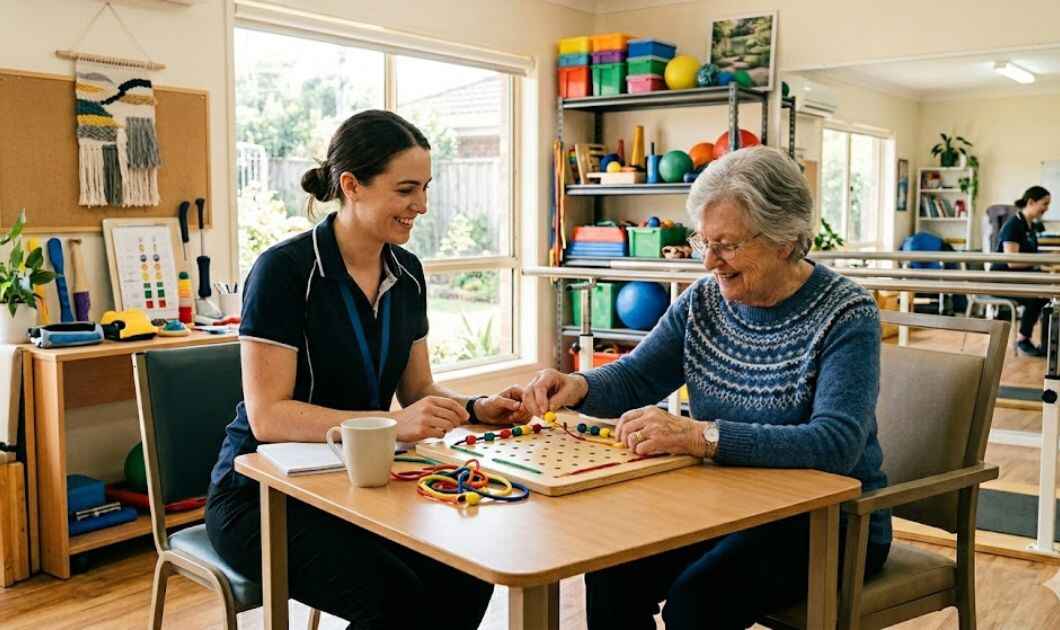
Nobody Really Knows What an Occupational Therapist Does. We Get That.
Seriously. We have lost count of how many people walk into our clinic, sit down, and quietly admit they are not entirely sure why they were referred to us or what is about to happen.
And honestly? That is not their fault. The name is confusing. “Occupational” sounds like it is about jobs. Therapy sounds like lying on a couch talking about your childhood. Neither of those things is what we do.
Here is the real version. Our occupational therapist team helps people do the stuff that fills their days. The practical, often invisible stuff that most of us never think about until it becomes hard or impossible. Doing up buttons. Making toast. Sitting through a school lesson without completely falling apart. Getting back behind a desk after three months off with a wrist injury. Remembering where you put your keys. Feeling safe walking to the bathroom at night.
When something takes those things away, whether it is a stroke, a diagnosis your child just received, a hand injury, a mental health period that has quietly shrunk your world, or just the slow accumulation of getting older, that is when an occupational therapist becomes genuinely useful. That is what we are here for in Trusta Clinic.
Why We Built This Clinic in the First Place
We are not going to pretend Dubai was desperately short of healthcare options when we opened. It was not.
What we kept seeing, though, was people finishing treatment programs elsewhere and still struggling with the same daily tasks they came in with. They had done the sessions. They had the discharge notes. But their actual life had not changed much. Because somewhere along the way, the connection between the clinic and the real world had gotten lost.
That is the problem our occupational therapy clinic was built to solve. We want every single thing that happens in a session to connect directly back to something that matters in your life outside these walls. That sounds obvious. In practice, it is surprisingly rare.
Occupational therapy in Dubai has grown a lot in recent years. The demand is real and the awareness is building. We want to be the clinic that does it properly, not just adequately.
The People We See Every Week
Our clients are genuinely varied and that is something we value a lot about this work.
Families with children who are finding things hard
Some parents come to us with a school report. Others come because something has been nagging at them for months and they finally trusted that instinct enough to book an appointment. Their child might be avoiding getting dressed because certain fabrics feel unbearable. Or running into walls constantly because their body does not quite know where it is in space. Or holding a pencil so awkwardly that writing a single paragraph leaves their hand in pain.
These are not behaviour problems. They are not signs of a child who is not trying hard enough. They are usually signs that the child’s nervous system or motor development needs some focused support from someone who actually knows what they are looking at.
Our paediatric occupational therapy services cover autism spectrum disorder and the sensory challenges that often come with it, developmental delays in movement and self-care, ADHD that is making school and home genuinely difficult, cerebral palsy, handwriting and fine motor struggles, sensory integration disorder, and learning differences that affect how a child participates in class. We do not need a neat diagnosis to get started. We assess the child who is actually in front of us.
Adults whose lives changed because of injury or illness
Some of our adult clients come to us soon after something happened. Others have been managing a condition for years and have reached a point where they need more support than they have been getting.
We see stroke survivors who want to get back to dressing themselves, cooking their own meals, going back to work. We see people with hand injuries where the bone healed fine but the function never fully came back. We see professionals with repetitive strain conditions that crept up so gradually they are almost surprised by how much they have lost. We see people whose anxiety or depression did not arrive dramatically but slowly made their world smaller until they look up one day and realise they have stopped doing most of the things they used to enjoy.
Our occupational therapy treatment for adults is always about the specific life that specific person is trying to reclaim. Not a generic recovery pathway.
Older adults who are not ready to hand over their independence
This is a group we think about a lot. Losing the ability to do things for yourself is frightening in a way that goes beyond the physical inconvenience. It changes how people see themselves. Our occupational therapy rehabilitation for older adults starts from a place of real respect for that. We focus on what someone wants to keep doing and we work backwards from there.
What Coming to Our Occupational Therapy Clinic Actually Looks Like
The first session
Mostly talking, if we are honest. We ask about your medical history but we spend just as much time asking about your day. What your mornings look like. Which specific moments have become difficult. What you have quietly stopped doing because it got too hard. What you are hoping to get back. We watch how you move, how you process things, how you respond to different inputs. We think about where you live and where you work because the same condition can show up very differently depending on the environment a person is in.
You should leave that first session feeling like someone actually listened. Not processed, listened. And we should have enough of a real picture to start building something that fits your life rather than just your diagnosis.
Your occupational therapy program
Not a template. Not a protocol with your name typed at the top. Every goal in your occupational therapy program in Trusta Clinic comes directly from your life and what you told us matters to you. If you ever sit in a session thinking “I do not understand how this connects to what I am trying to achieve,” say it out loud. Because there should always be a clear answer.
The methods vary a lot depending on the person. For some clients it is mostly practical functional retraining, rebuilding the ability to do specific tasks through careful, progressive practice that mirrors real life. For others, cognitive rehabilitation is the core of the work, using structured exercises, memory strategies, and practical tools to help the brain function better day to day. For children with sensory processing challenges, sensory integration therapy takes up a big part of our sessions, carefully designed work that gradually helps the nervous system handle sensory input more predictably and comfortably.
Hand and upper limb therapy is honestly one of the areas we are most proud of in Trusta Clinic. Our occupational therapist team has built real depth of expertise here over the years. Whether it is a fresh injury, a post-surgical hand that is not quite right yet, or a long-term condition like carpal tunnel syndrome or rheumatoid arthritis affecting hand function, we combine manual treatment, custom splinting, progressive exercise, and real task-based retraining. People often make faster progress here than they expected. We are not going to pretend that does not feel good for everyone in the room.
We also look hard at environments. A proper home visit or workplace assessment sometimes does more practical good than weeks of clinic sessions because removing an actual barrier in someone’s kitchen or fixing their workstation setup has an immediate, tangible effect on their daily life.
For people returning to work, our vocational rehabilitation work addresses the specific demands of the actual job, not some theoretical version of employment. And for clients whose mental health has been quietly eating away at their daily functioning, we do not separate that out and treat it as someone else’s problem. Routine building, meaningful activity, practical coping strategies, all of that sits inside occupational therapy treatment by Trusta Clinic.
What We Actually Look For When We Hire an Occupational Therapist
Qualifications, yes. Every occupational therapist here holds a recognised degree, is registered with the relevant UAE authorities, and meets Dubai’s professional practice standards. That is baseline.
Above that, we hire for something harder to put on a CV.
It is the occupational therapist who notices a client seems quieter than usual before the session even starts and asks about it. The one who redesigns a whole activity around the fact that a child mentioned loving dinosaurs three sessions ago, because they were paying close enough attention to remember. The one who picks up the phone and calls an employer directly because a workplace accommodation conversation needed to happen and nobody else was going to make it happen.
That kind of attention is what our occupational therapy clinic runs on. It is not accidental. We hire for it and we work to protect it.
When you work with our team, here is what that looks like in practice. An unhurried first assessment with honest feedback. A personalised occupational therapy program built around goals that genuinely motivate you. Consistent one-to-one sessions where you are the full focus of the appointment. Regular honest reviews where we actually change things when something is not working. Clear guidance for anyone supporting you at home. Coordination with your other treating clinicians when a joined-up approach is what the situation needs. Written reports or functional assessments for school, insurance, legal, or workplace purposes whenever you need them.

Before

After
A Straight Talk About the Occupational Therapy Rehabilitation Timeline
Recovery is not linear. We know that sounds like a disclaimer but it is actually important.
There will be sessions that feel like breakthroughs. There will be sessions where you leave wondering if anything is happening at all. Both are normal parts of genuine occupational therapy rehabilitation. What we commit to is that every step is intentional, we will always tell you honestly where things stand, and we will change direction when something is not working rather than plodding along a path that stopped being useful.
The shape of the journey: a real assessment to understand your actual situation, building the occupational therapy program together with your genuine input, an active treatment phase with clinic sessions running alongside a home or work programme so you are not just making progress on Tuesdays and Thursdays, formal reviews at regular intervals, and then early preparation for life after clinic. That last part matters to us. We start thinking about discharge long before it happens because leaving our care with the skills and confidence to maintain your own progress is the whole point. If you still need us indefinitely, we have not done the job properly.
Occupational Therapy in Dubai: The City Is Not Like Anywhere Else
We think about this a lot. Dubai has one of the most diverse populations of any city in the world. Families from dozens of countries, each carrying different cultural expectations around disability and rehabilitation and whether asking for professional help is something you do. Professionals under intense performance pressure. Children in international schools navigating competitive and demanding curriculums far from extended family. Older expats who did not plan on needing care so far from home.
Occupational therapy in Dubai has to account for all of that. Our occupational therapy services are designed to be genuinely flexible and culturally aware, not a Western clinical model applied rigidly to people whose lives do not fit inside it. We ask questions. We stay curious. We adapt. Because what good occupational therapy treatment looks like varies enormously depending on who the person is and how they live.
That adaptability, sitting alongside the clinical depth of our occupational therapist team, is why so many families and professionals across the city keep coming back to Trusta Clinic and telling their friends about us.
What Clients Actually Tell Us Made the Difference
We ask about this regularly because it keeps us honest about what is actually working.
The things that come up again and again: feeling genuinely heard at that first appointment rather than just assessed. Goals being treated as specific and important rather than smoothed into a standard pathway. The occupational therapist remembering what they told them two sessions ago and building on it. Someone finally explaining what was happening in plain language. And when progress slowed, someone saying so honestly and actually changing the approach rather than continuing with the same plan while hoping for different results.
Those are the things that matter to us more than anything else. More than any certificate on a wall.
What Our Occupational Therapy Services Cover
Autism spectrum disorder. Stroke recovery, both early and longer-term. Acquired and traumatic brain injury. Cerebral palsy. Developmental coordination disorder. ADHD across ages. Hand injuries including fractures, tendon repairs, and nerve damage. Carpal tunnel syndrome and upper limb repetitive strain. Post-surgical rehabilitation for the shoulder, elbow, wrist, and hand. Parkinson’s disease. Multiple sclerosis. Dementia and cognitive decline. Anxiety, depression, and burnout reducing daily function. Spinal cord injury. Rheumatoid and osteoarthritis of the hand and upper limb. Burns and complex upper limb wounds.
Not on that list? Call us anyway. Our occupational therapist will give you a straight and honest answer about whether our occupational therapy services are the right fit. And if they are not, we will tell you who might be better placed to help rather than just leaving you to figure it out alone.
Things People Ask Us Before They Book
How is an occupational therapist different from a physiotherapist? The straightforward answer is that they work on different things and they work well together. A physiotherapist focuses on physical movement and pain. Our occupational therapist focuses on your ability to function in your actual daily life. We have both here in Trusta Clinic and they collaborate on a lot of our clients.
How long will the occupational therapy program take?
Genuinely depends on the person and the goals. Some clients get where they need to be in six or eight sessions. Others are on a longer occupational therapy rehabilitation journey. We talk about realistic expectations from your very first appointment and we revisit them regularly.
Do I need a referral?
Usually not. Most people contact us directly. If your insurer requires a referral we will explain what is needed and help you sort it.
Is occupational therapy treatment covered by insurance?
Many UAE health plans do include coverage for occupational therapy in Dubai. Worth checking with your insurer before the first appointment. We help with pre-authorisation paperwork on our end when needed.
Can you help my child manage better at school?
Yes, and it is one of the most common reasons families come to us. We assess, we treat, and we write detailed reports that schools actually use to put real accommodations in place.
Come and Talk to Us. That Is All You Need to Do First.
You do not need to have everything figured out before you reach out. You do not need a specific diagnosis or a carefully prepared list of questions. You just need to show up and tell someone on our team what has been getting harder.
We will listen. Properly. We will be honest about what we can offer and whether we are the right fit. And if we are, we will build an occupational therapy program around your actual life, your actual goals, and what actually matters to you day to day.
That is what occupational therapy in Dubai should feel like. A genuine partnership with people who are paying attention.
Trusta Clinic, Dubai. Your daily life deserves its full range back.
