
Hair Transplant Treatment: Restore Natural Hair Growth
Transform your look through professional hair transplant treatment in Dubai. Hair loss impacts appearance and self-esteem, so our specialists provide modern solutions to rebuild thinning areas and restore natural density. Androgenetic alopecia, poor nutrition, stress, and environmental changes often cause gradual thinning.
Our specialists provide hair implant treatment and hair follicle surgery & treatment, with natural growth ensured throughout. Using FUE hair transplant, Trusta Medical Center delivers natural hairline design, improved density, and results trusted across Dubai. Each plan is customized for individuals, and permanent restoration with natural hair growth remains the goal in every case.
Because of this, advanced techniques and customized care come together to help you achieve healthier-looking hair and renewed confidence.
Don’t wait to restore your hairline. Schedule your consultation today and experience expert hair follicle surgery & treatment.

What Is a Hair Transplant?
Achieve natural beauty with professional hair transplant treatment. This surgical solution transfers healthy follicles into thinning or bald areas. Donor follicles from the scalp’s sides or back ensure permanent growth, so unlike temporary treatments, a transplant restores hair where it has disappeared.
As a result, fuller hairlines, improved density, and natural-looking coverage become achievable. Trusta Medical Center offers hairline treatment with FUE and DHI techniques, chosen by patients who want natural results and renewed confidence.
How Does a Hair Transplant Treatment Work?
Every procedure follows the same principle: healthy follicles are removed from donor zones and implanted into thinning areas in a natural growth pattern. However, precision, tools, and surgeon skill are what set Trusta Medical Center apart.
Trusta Medical Center’s FDA-certified surgeon evaluates your scalp, hair loss pattern, and donor availability before recommending FUE Hair Transplant in Dubai or DHI. No method works universally better than the other; instead, the right choice depends on your scalp condition and goals. Advanced hair growth treatment and hairline treatment support both approaches.
Overall, natural results, improved density, and permanent restoration remain guaranteed, combining expertise and technology to deliver confidence.

Why Patients Trust Trusta Medical Center for Hair Transplant Treatment
Patients searching for the best hair transplant clinic in Dubai should focus their decision on licensing, surgeon expertise, and follow-up care rather than price. Because Trusta Medical Center operates under a Dubai Health Authority (DHA) license, every procedure meets strict hygiene and clinical standards.
Here is what sets the clinic apart for patients comparing options:
- DHA-licensed facility in Downtown Dubai reviewed annually
- An FDA-certified hair transplant surgeon performing every procedure personally
- Over 36,000 successful treatments completed across the clinic’s history
- Sterile hospital-grade environment
- Customized hairline design reviewed with you before surgery
Since results depend on surgical skill, this combination of licensing, experience, and surgeon involvement makes Trusta Medical Center the trusted choice for hair restoration in Dubai.
Hair Transplant Types at Trusta Medical Center
FUE Hair Transplant Dubai
FUE Hair Transplant delivers advanced hair transplant treatment with natural results. This method extracts individual follicular units using a fine micro-punch tool, then implants them one by one into thinning areas.
Since no strip of scalp is removed, FUE leaves no linear scar, only tiny scattered dots that fade over time.
Therefore, many patients prefer this technique for large-scale restoration, improved density, and faster recovery. Trusta Medical Center’s FDA-certified surgeon ensures precision, artistry, and permanent growth, making FUE the trusted choice for hair restoration in Dubai.
DHI Hair Transplant Dubai
DHI Hair Transplant Dubai offers advanced hair transplant treatment with precision. Using a specialized pen-like tool, each follicle is implanted directly without creating a channel first.
As a result, this gives the surgeon complete control over depth, angle, and direction, vital in visible areas such as the hairline, temples, and crown where density matters most. Because of this precision, many patients choose DHI for natural results in smaller, delicate zones.
| Feature | FUE Hair Transplant | DHI Hair Transplant |
|---|---|---|
| Tool used | Micro-punch extraction device | Choi implanter pen |
| Scarring | Minimal, scattered dot-scarring | Minimal to none |
| Best for | Large-area restoration | Hairline & density-focused zones |
| Session length | 4–8 hours | 6–10 hours, graft-dependent |
| Recovery speed | Fast | Fast, slightly more controlled |
Benefits of a Hair Transplant Treatment
- Permanent results: transplanted follicles resist baldness hormones for lasting growth
- Natural appearance: hairline treatment with FUE and DHI ensures seamless density
- A one-time investment: once healed, no daily routine is required
- Minimal downtime: recovery allows most patients to resume work quickly
- Renewed confidence: enjoy comfort in social settings, swimming, and photography within months
Best Ideal Candidates for a Hair Transplant
Every patient’s journey is unique. In fact, candidacy depends on scalp health, donor density, and hair loss type, not just visible thinning. Because of this, Trusta Medical Center’s FDA-certified surgeon reviews scalp health, donor density, and hair loss patterns before recommending hair implant treatment.
Good candidates typically include:
- Individuals with stable male pattern baldness affecting crown, temples, or hairline
- Individuals with diffuse thinning or widening parting lines
- Patients with a strong, healthy donor zone at the back or sides of the scalp
- Anyone with localized hair loss from scarring, burns, or prior procedures
- Adults with stabilized hair loss patterns
Areas Treated With a Hair Transplant
While the scalp is the most common treatment area, the same follicular techniques used for a hair transplant apply to several other areas of the face and body.
- Hairline and frontal scalp: restoring natural balance and definition
- Crown and vertex: covering bald patches with permanent density at the back of the head
- Temples: restoring youthful definition and facial framing
- Eyebrows: fine, single-hair grafts for natural eyebrow transplant density
- Beard and moustache: addressing sparse facial hair with our beard hair transplant
- Scar coverage: rebuilding growth over burns, injuries, or past surgery
Hair Transplant Treatment Procedure Step-by-Step
- Consultation and scalp analysis: trichoscopy examination, donor density measurement, and a detailed conversation about your goals
- Hairline design: surgeon designs a natural hairline, reviewed and approved before surgery
- Local anaesthesia and extraction: follicles are removed from the donor zone under local anaesthesia, not general
- Implantation: grafts placed in natural growth direction using hair follicle surgery & treatment with FUE or DHI
- Aftercare briefing: written instructions, medication, and follow-up schedule provided
Overall, sessions last four to eight hours depending on graft count, with same-day discharge.
What to Expect After Hair Transplant
| Timeframe | What Happens |
|---|---|
| Days 1–3 | Mild swelling and redness around the forehead; tiny scabs form |
| Week 1–2 | Scabs shed naturally; gentle washing begins under guidance |
| Week 2–6 | Shock loss — transplanted hair sheds; this is normal, follicles stay alive beneath the skin |
| Month 3–4 | Fine new hair begins emerging |
| Month 6–9 | Visible thickening and density improvement |
| Month 12–18 | Final results: full density and natural texture |
Hair follicle surgery & treatment demands patience for success. Indeed, shedding during months two to four is normal and signals proper healing. Most patients resume office work within five to seven days, though intense workouts should wait several weeks.
Book Your Consultation
Ready to restore your hairline? Schedule a consultation with Trusta Medical Center’s FDA-certified surgeon and get a personalized assessment of your scalp, hair loss pattern, and donor availability. Book today and take the first step toward natural, permanent results.
our expert answers
Frequently Asked Questions
Is a hair transplant actually permanent?
Yes. The follicles transplanted come from donor-dominant zones that are naturally resistant to the hormone responsible for hair loss. Once they take hold, they keep growing for life.
How much does a hair transplant cost in Dubai?
It depends on your graft count, chosen technique, and case complexity. We provide a personalized quote after consultation rather than a generic number that won't apply to your case.
Does the procedure hurt?
You'll be under local anesthesia throughout the surgery itself, so there's no pain during the procedure. Mild sensitivity afterward is normal and manageable.
When will I see my final results?
Early growth starts around month three, but final, full density typically shows between months twelve and eighteen.
How long is recovery before I can go back to work?
Most patients return to their normal routine within seven to ten days, following the specific aftercare instructions provided after surgery.
Hair Transplant Treatment: Before and After
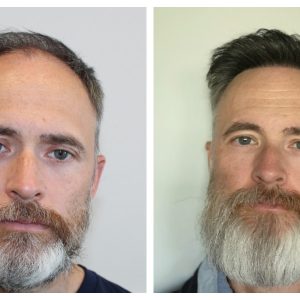
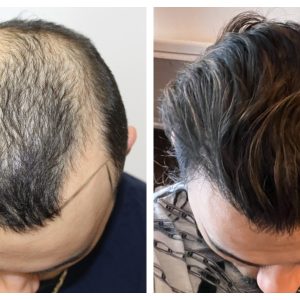
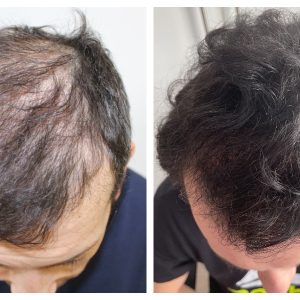
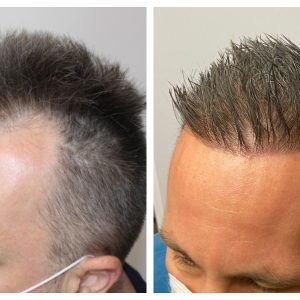
Before-and-after photos prove what hair growth treatment can achieve. Patients move from thinning to density over 12–18 months, with the most dramatic change between months six and twelve.
A few things worth keeping in mind when comparing before-and-after results:
- Early photos (months 1–3) often show shedding, which is normal
- Lighting and camera angle affect how dramatic results appear
- Natural transformations take time, not overnight
You are welcome to visit the Trusta Hair Transplant service page for updated patient transformations, graft counts, and cost details.
Is a Hair Transplant in Dubai Safe?
Yes. The procedure is performed by a qualified surgeon in a DHA-licensed facility. Hair transplant treatment is minimally invasive and performed under local anaesthesia. Its safety profile is strong when modern techniques are applied correctly, and clinical studies confirm follicle survival rates above 90%. FUE hair implant treatment delivers proven results.
Still, no surgical procedure is entirely risk-free. Possible side effects include:
- Temporary swelling around the forehead or eyes
- Mild redness or itching during healing
- Shock loss (temporary, expected shedding)
- A rare risk of infection if aftercare instructions are not followed
DHA licensing, FDA-certified expertise, and advanced technology combine to deliver safe, natural, and permanent results.
 Posted on Google
 amitisful
Trustindex verifies that the original source of the review is Google.
Amazing experience! The staff were wonderful and I’m very happy with the results. I’ll definitely come backThis is truly a state-of-the-art beauty clinic. The facilities, technology, and range of services available here are exceptional, and you won’t easily find the same level of comprehensive care in other clinics. As a physician, I highly recommend visiting this clinic. It is truly in a class of its own when it comes to aesthetic medicine, offering a complete range of beauty and aesthetic services, from surgical to non-surgical treatments, all under one roof..❤️❤️❤️Posted on Google Helmi Emadما شاء الله موقع ممتاز عيادة نظيفة تحسهم من المستقبل أما الاستقبال مررررة أدب تستأنث وياهم الصراحة ما تحس نفسك في عيادة من شدة إهتمام الدكاترة وباقي التيم كله متوفر عندهم مواقف سيارات مجانية ومصعد لذوي الاحتياجات الخاصة أشكر أصدقائي على التوصية بي عيادة ترستا واتمنى لكم التوفيق والنجاحPosted on Google
 Sahar GeramiPosted on Google
 Donna AskariAmazing clinicPosted on Google
 Farnaz Saeedi⭐⭐⭐⭐⭐ I had a great experience at Trusta Clinic. The staff were very professional, friendly, and welcoming. The clinic is clean, modern, and well-organized, and I really appreciated the attention to detail and the quality of service. Highly recommended! I’ll definitely be coming back. ❤️Posted on Google
 Layth SalhabAbsolutely amazing experience at Trusta Medical Center! ⭐️⭐️⭐️⭐️⭐️ The clinic is beautiful, modern, and very clean. The team is professional, welcoming, and genuinely attentive from the moment you arrive. You can really feel the high standard of care and attention to detail. Highly recommended for anyone looking for quality medical and aesthetic services in Dubai. 👌🏻✨Posted on Google
 sahra rezvanpanah⭐⭐⭐⭐⭐ I had a wonderful experience at Trusta Clinic, from the initial consultation all the way through my cosmetic procedure. Everyone, from the staff to the doctors, was incredibly supportive, caring, and attentive throughout the entire process. I truly felt that I was surrounded by people who genuinely cared about me, almost as if I were among friends. I’m very happy with my experience and would definitely recommend Trusta Clinic to anyone considering a cosmetic procedure.Posted on Google
 Mohammed AbdalraheemA lovely experience at Trusta Medical Center. The staff are kind, welcoming, and very professional, and the clinic has a clean and comfortable atmosphere. I truly appreciated the attention to detail, the respectful way everything was explained, and the high standard of care. The doctors are carefully selected and clearly experienced in their fields. A very pleasant and trustworthy medical center that I would happily recommend to others.Posted on Google
 Isis Aamn💖💖🌹 I had a very pleasant experience at Trusta Medical Center. The clinic is clean, elegant, and well organized, and the staff were welcoming and professional from the moment I arrived. I was especially impressed with the aesthetic medicine services. The doctors are highly professional, attentive, and take time to explain everything clearly. The prices are also reasonable and transparent. A very comfortable and trustworthy medical center. Highly recommended!🌹💖Posted on Google
 Ayden⭐⭐⭐⭐⭐ I had a wonderful experience at Trusta Medical Center. From the moment I arrived, the reception team was welcoming, professional, and very well organized. The entire clinic has a clean, elegant, and comfortable atmosphere, which immediately gives you a sense of confidence and trust. I was particularly impressed by their Aesthetic Medicine Department. The team takes the time to understand each patient’s concerns and expectations, and everything is explained clearly before making any decision. Their approach feels professional and patient-centered rather than commercial. The clinic also seems very selective in choosing its doctors. The medical team is experienced, knowledgeable, and genuinely focused on achieving natural and appropriate results while maintaining high standards of safety. Another positive point was the transparency regarding prices and treatment options. Everything was explained clearly, with no unnecessary pressure to undergo additional procedures. Overall, Trusta Medical Center is an excellent polyclinic that combines professional medical care, hospitality, cleanliness, fair pricing, and highly qualified doctors under one roof. I would confidently recommend it to anyone looking for a reliable medical center in Dubai, especially for aesthetic medicine. A truly five-star experience. Highly recommended. ❤️Verified by TrustindexTrustindex verified badge is the Universal Symbol of Trust. Only the greatest companies can get the verified badge who has a review score above 4.5, based on customer reviews over the past 12 months. Read more