
Pelvic Ultrasound for Women
A scan answers in fifteen minutes what months of guessing cannot. Trusta Medical Center performs pelvic ultrasound at our Downtown Dubai clinic, checking the uterus, ovaries, and surrounding structures for fibroids, cysts, lining changes and early pregnancy. Our gynecologist reads the images alongside your symptoms, then explains what they show before you leave. No waiting on a report. Book your pelvic ultrasound today.
Why Patients Choose Trusta for Pelvic Ultrasound
- Results explained in the same visit by the gynecologist who ordered the scan, not by email days later.
- Both scan types available; so we use whichever answers your question, or both together.
- Booked to your cycle; because timing changes what the lining and follicles show.
- A female sonographer on request; just mention it when you book.
- Treatment continues here; if the scan finds something, you stay with the same team.
- Private, unhurried appointments; with everything explained before it happens.

What a Pelvic Ultrasound Shows: Our Expert Explains
So sound waves build a live image of your reproductive organs. No radiation, and nothing accumulates across repeat scans.
Meanwhile, our sonographer looks at the uterus, the ovaries, the cervix, and the tissue around them. Size, shape, structure, and anything that should not be there.
Conditions We Look For in Pelvic Ultrasound
Fibroids
These are common, non-cancerous growths in the uterine wall. A scan shows how many, how large, and exactly where they sit, which decides whether they need treating at all.
Ovarian Cysts
Most are simple, fluid-filled and resolve on their own within a couple of cycles. Still, some need a closer look. Ultrasound distinguishes those from complex cysts that warrant a closer look.
Endometrial Thickness
The lining thickens and thins across your cycle, so timing changes the reading. Measuring it helps explain abnormal bleeding, and it matters during fertility treatment.
Polycystic Ovaries
Multiple small follicles arranged around the edge of each ovary produce a characteristic appearance. That finding forms one part of a PCOS diagnosis, alongside your hormone results and cycle history. Our fertility tests page covers the full picture.
Suspected Endometriosis and Adenomyosis
Adenomyosis, where lining tissue grows into the uterine muscle, often shows on a transvaginal scan. Endometriosis is harder, because a normal scan does not rule it out. Your gynecologist will explain what the images can and cannot settle.
Uterine Shape Differences
Occasionally women are born with a differently shaped uterus. Finding that early matters for fertility and for pregnancy planning, and most women never knew.

Transabdominal or Transvaginal?
Two approaches, and they answer different questions. Your gynecologist chooses based on what needs seeing.
| Transabdominal | Transvaginal |
How it works | Probe moves across your lower abdomen | Slim covered probe inside the vagina |
Bladder | Full | Empty |
Image detail | Broad overview | Much sharper and closer |
Best for | Large fibroids, general view, first look | Ovaries, lining thickness, early pregnancy |
Comfort | No discomfort, apart from a full bladder | Mild pressure, no pain expected |
Takes | 10 to 15 minutes | 10 to 15 minutes |
Frequently we do both in one appointment. The abdominal scan gives the overview, then the transvaginal scan fills in the detail that matters.
Need Pelvic Ultrasound: If You Are Not Sexually Active
Patients ask this often, and the answer is simple. A transvaginal scan is not performed unless you agree to it.
When an internal scan is not appropriate or not wanted, we use the transabdominal approach instead. Image detail is lower, so occasionally we recommend a different test to answer the question properly. Nobody will pressure you, and nobody needs an explanation from you.
Best Time to Book Pelvic Ultrasound
Timing matters more than most patients realise, and getting it wrong sometimes means repeating the scan.
- Days 5 to 10; best for assessing the lining and checking for polyps, since the endometrium is at its thinnest.
- Mid-cycle; used for follicle tracking during fertility treatment.
- Any day; fine for suspected large fibroids, or when you have acute pain that needs investigating now.
So tell reception your cycle day when booking. Meanwhile if you have severe pain, come in regardless of timing, because urgent symptoms override the schedule.
Can You Have a Scan During Your Period?
Yes, and it is not a problem for our sonographers. Still, the images are usually clearer once bleeding has stopped.
For urgent pain or suspected early pregnancy complications, we scan whenever you need it. Routine assessment of the lining is different, so there we would rather wait a few days.
Preparing for Your Appointment
- Drink around a litre of water an hour before a transabdominal scan
- Do not empty your bladder once you arrive, until the sonographer says so
- Empty it before a transvaginal scan, which is the opposite requirement
- Wear loose two-piece clothing so your abdomen is easy to reach
- Bring previous scan reports if you have any
- Note your cycle day and the date your last period started
Nothing else is needed. No fasting, and you can eat normally beforehand.
What Happens During the Scan for Pelvic Ultrasound
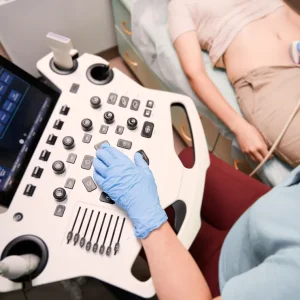
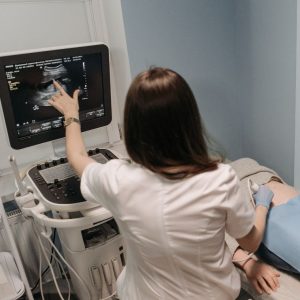
Overall, the appointment runs 15 to 30 minutes, including both approaches where needed. First, you lie on an examination couch. For the abdominal scan, warm gel goes onto your lower abdomen and the probe moves across it. Then, with the transvaginal approach, a slim covered probe goes in gently, although you may prefer to insert it yourself.
Your sonographer explains each step first. Tell her at any point if something feels uncomfortable, because the scan can pause.
Understanding Your Results
Your gynecologist reviews the images alongside your symptoms, your history and any bloodwork, usually in the same visit.
A scan on its own is only half an answer. Consider a 3cm fibroid, which means something quite different in a woman with heavy bleeding than in one with no symptoms. That is exactly why the images get read in context rather than reported in isolation.
Finally, if something needs following up, we arrange it before you leave.
Is a Pelvic Ultrasound Safe?
Yes. Ultrasound uses sound waves rather than ionising radiation, so there is no exposure and nothing builds up over repeated scans.
Also it is safe during pregnancy, safe to repeat as often as needed, and it carries no recovery time. You go straight back to your day afterwards.
Pelvic Ultrasound Cost in Dubai
Your cost depends on whether you need one approach or both, and also whether the scan forms part of a wider consultation.
Most UAE insurance plans cover pelvic ultrasound when a doctor has requested it for symptoms or a clinical reason. Cover for scans requested without symptoms varies considerably. Send your policy to reception beforehand and they will confirm what applies before you attend.
Book Your Pelvic Ultrasound
Pelvic pain, heavy bleeding or an irregular cycle deserves an answer rather than another month of waiting. Book a pelvic ultrasound at our Downtown Dubai clinic and get your results explained the same visit. Routine gynecological imaging also forms part of our women preventive health service.
our expert answers
Frequently Asked Questions
Is a pelvic ultrasound painful?
A transabdominal scan feels like light pressure on your belly. A transvaginal scan can feel slightly unusual but should not hurt.
How should I prepare for a USG pelvis scan?
Drink water and keep your bladder full for a transabdominal scan. Our sonographer will let you know if an empty bladder is needed for the transvaginal portion.
Can a pelvic ultrasound detect pregnancy?
A transvaginal ultrasound can confirm pregnancy earlier than a transabdominal scan, often as soon as five to six weeks.
How long does a pelvic scan take?
Most appointments take fifteen to thirty minutes, including both transabdominal and transvaginal views when needed.
 Posted on Google
 amitisful
Trustindex verifies that the original source of the review is Google.
Amazing experience! The staff were wonderful and I’m very happy with the results. I’ll definitely come backThis is truly a state-of-the-art beauty clinic. The facilities, technology, and range of services available here are exceptional, and you won’t easily find the same level of comprehensive care in other clinics. As a physician, I highly recommend visiting this clinic. It is truly in a class of its own when it comes to aesthetic medicine, offering a complete range of beauty and aesthetic services, from surgical to non-surgical treatments, all under one roof..❤️❤️❤️Posted on Google Helmi Emadما شاء الله موقع ممتاز عيادة نظيفة تحسهم من المستقبل أما الاستقبال مررررة أدب تستأنث وياهم الصراحة ما تحس نفسك في عيادة من شدة إهتمام الدكاترة وباقي التيم كله متوفر عندهم مواقف سيارات مجانية ومصعد لذوي الاحتياجات الخاصة أشكر أصدقائي على التوصية بي عيادة ترستا واتمنى لكم التوفيق والنجاحPosted on Google
 Sahar GeramiPosted on Google
 Donna AskariAmazing clinicPosted on Google
 Farnaz Saeedi⭐⭐⭐⭐⭐ I had a great experience at Trusta Clinic. The staff were very professional, friendly, and welcoming. The clinic is clean, modern, and well-organized, and I really appreciated the attention to detail and the quality of service. Highly recommended! I’ll definitely be coming back. ❤️Posted on Google
 Layth SalhabAbsolutely amazing experience at Trusta Medical Center! ⭐️⭐️⭐️⭐️⭐️ The clinic is beautiful, modern, and very clean. The team is professional, welcoming, and genuinely attentive from the moment you arrive. You can really feel the high standard of care and attention to detail. Highly recommended for anyone looking for quality medical and aesthetic services in Dubai. 👌🏻✨Posted on Google
 sahra rezvanpanah⭐⭐⭐⭐⭐ I had a wonderful experience at Trusta Clinic, from the initial consultation all the way through my cosmetic procedure. Everyone, from the staff to the doctors, was incredibly supportive, caring, and attentive throughout the entire process. I truly felt that I was surrounded by people who genuinely cared about me, almost as if I were among friends. I’m very happy with my experience and would definitely recommend Trusta Clinic to anyone considering a cosmetic procedure.Posted on Google
 Mohammed AbdalraheemA lovely experience at Trusta Medical Center. The staff are kind, welcoming, and very professional, and the clinic has a clean and comfortable atmosphere. I truly appreciated the attention to detail, the respectful way everything was explained, and the high standard of care. The doctors are carefully selected and clearly experienced in their fields. A very pleasant and trustworthy medical center that I would happily recommend to others.Posted on Google
 Isis Aamn💖💖🌹 I had a very pleasant experience at Trusta Medical Center. The clinic is clean, elegant, and well organized, and the staff were welcoming and professional from the moment I arrived. I was especially impressed with the aesthetic medicine services. The doctors are highly professional, attentive, and take time to explain everything clearly. The prices are also reasonable and transparent. A very comfortable and trustworthy medical center. Highly recommended!🌹💖Posted on Google
 Ayden⭐⭐⭐⭐⭐ I had a wonderful experience at Trusta Medical Center. From the moment I arrived, the reception team was welcoming, professional, and very well organized. The entire clinic has a clean, elegant, and comfortable atmosphere, which immediately gives you a sense of confidence and trust. I was particularly impressed by their Aesthetic Medicine Department. The team takes the time to understand each patient’s concerns and expectations, and everything is explained clearly before making any decision. Their approach feels professional and patient-centered rather than commercial. The clinic also seems very selective in choosing its doctors. The medical team is experienced, knowledgeable, and genuinely focused on achieving natural and appropriate results while maintaining high standards of safety. Another positive point was the transparency regarding prices and treatment options. Everything was explained clearly, with no unnecessary pressure to undergo additional procedures. Overall, Trusta Medical Center is an excellent polyclinic that combines professional medical care, hospitality, cleanliness, fair pricing, and highly qualified doctors under one roof. I would confidently recommend it to anyone looking for a reliable medical center in Dubai, especially for aesthetic medicine. A truly five-star experience. Highly recommended. ❤️Verified by TrustindexTrustindex verified badge is the Universal Symbol of Trust. Only the greatest companies can get the verified badge who has a review score above 4.5, based on customer reviews over the past 12 months. Read more