
May 20, 2026
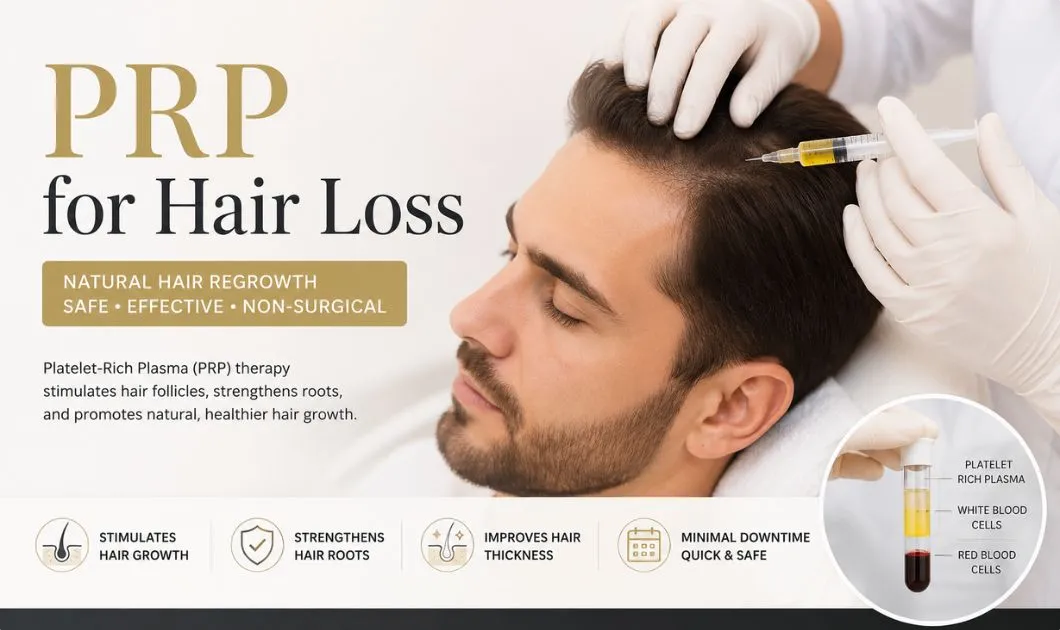
Not every hair loss patient needs a transplant. For many men and women in Dubai experiencing the early stages of thinning, diffuse shedding, or hair loss that has not yet reached surgical territory, PRP for Hair Loss in Dubai offers a scientifically supported, non-surgical route to healthier, denser hair.
PRP uses your body’s own biology to do the work. By concentrating the growth factors naturally present in your blood and delivering them directly to the scalp, PRP stimulates dormant follicles, improves blood supply to the hair root, and extends the active growth phase of the hair cycle. As part of our comprehensive approach to Hair Restoration in Dubai, PRP therapy in Trusta Clinic in Downtown Dubai is administered by DHA-licensed specialists in a clinical environment, not a beauty salon.
What Is PRP Therapy for Hair Loss?
How Platelet-Rich Plasma Stimulates Hair Follicles
Blood contains red blood cells, white blood cells, and platelets suspended in plasma. Platelets are best known for their role in clotting, but they also carry an array of potent growth factors including Platelet-Derived Growth Factor (PDGF), Vascular Endothelial Growth Factor (VEGF), and Insulin-like Growth Factor (IGF) that play a documented role in tissue repair, cell regeneration, and follicle health.
In PRP therapy, a small sample of your blood is drawn and processed in a medical centrifuge that separates and concentrates the platelet-rich fraction. This concentrated PRP containing up to 5–8 times the baseline platelet concentration is then injected into the scalp at the level of the hair follicle. The growth factors released stimulate follicle cells, improve blood supply to the dermal papilla, reduce inflammation, and help transition dormant (telogen phase) follicles back into the active growth (anagen) phase.
What Does the Research Show?
PRP for hair loss has been the subject of a growing body of peer-reviewed research. Multiple controlled studies have demonstrated statistically significant improvements in hair density, hair diameter, and the anagen-to-telogen ratio in patients treated with PRP compared to control groups. A 2019 systematic review published in the journal Aesthetic Plastic Surgery concluded that PRP shows promising efficacy for androgenetic alopecia in both men and women. While PRP is not a cure it does not reverse genetic programming it is a meaningful, evidence-based treatment that can slow progression and meaningfully improve density in appropriate candidates.
Who Is PRP Right For?
Early-Stage Hair Loss (Norwood I–III in Men, Ludwig I–II in Women)
PRP is most effective when follicles are still present but weakened or miniaturised meaning they are producing thinner, shorter hairs than they once did. At this stage, the growth factors in PRP can potentially reverse miniaturisation and restore healthier hair growth. Once follicles are completely gone and the area is smooth and bald, PRP cannot create new follicles this is where hair transplantation becomes necessary.
Female Hair Thinning
PRP is particularly well suited for women experiencing androgenetic alopecia (female pattern hair loss), telogen effluvium triggered by hormonal changes, post-partum hair shedding, or general diffuse thinning. Women are often not candidates for hair transplantation due to the diffuse nature of their hair loss, making PRP one of the most viable medical interventions available.
Post-Transplant PRP – Accelerating Your FUE Results
PRP has been shown to improve graft survival and accelerate new hair growth when administered in conjunction with hair transplant surgery or in the weeks following. At Trusta Clinic, we frequently recommend PRP therapy as a complement to FUE supporting the healing environment and potentially improving the density and speed of results.
Who Is NOT a Good Candidate for PRP?
PRP is not appropriate for patients with:
- Active scalp infections or psoriasis
- Blood disorders or platelet dysfunction conditions
- Patients on anticoagulant medication (blood thinners)
- Haematological cancers
- Patients with unrealistic expectations of complete regrowth in areas of total baldness
The PRP Hair Treatment Process at Trusta Clinic
Step 1 — Blood Draw
A small amount of blood typically 15–20ml is drawn from your arm in the same way as a routine blood test. The process takes approximately 5 minutes and is no more uncomfortable than any standard venepuncture.
Step 2 — Centrifuge Processing
The blood sample is placed in a medical centrifuge and spun at high speed for approximately 10–12 minutes. This separates the blood into its component layers, allowing us to isolate the platelet-rich plasma from the red blood cells and other components.
Step 3 — PRP Activation (Optional)
In some protocols, a small amount of calcium chloride or thrombin is added to the PRP to activate the platelets before injection, prompting the immediate release of growth factors.
Step 4 — Scalp Injection
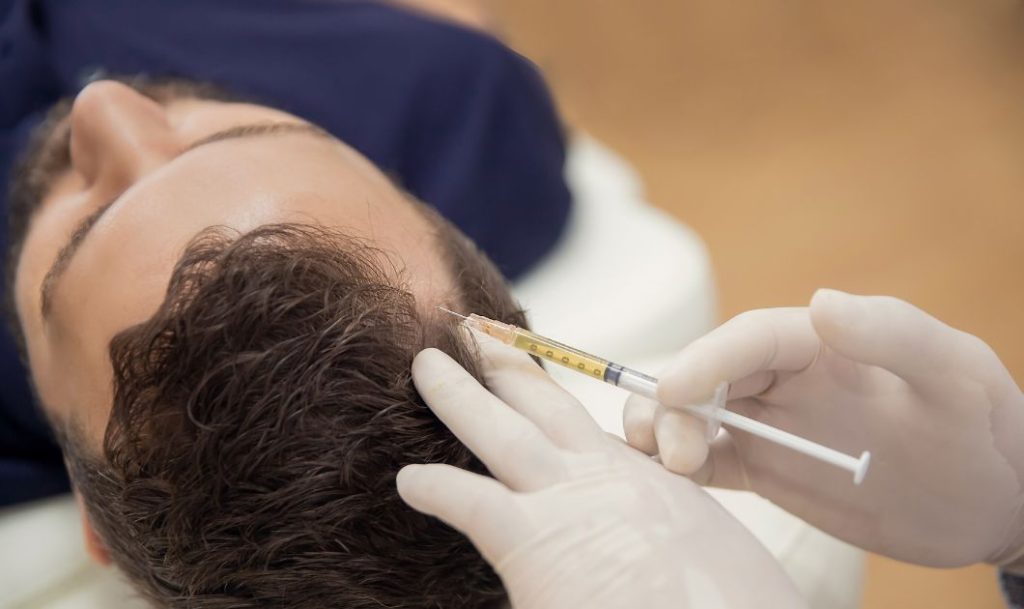
Using a fine needle, the PRP is injected across the scalp in a systematic pattern at the level of the hair follicle typically the subdermal layer. A topical anaesthetic cream is applied before the injections to minimise discomfort. Most patients describe the sensation as mild stinging or pressure rather than pain. The injection phase takes approximately 20–30 minutes.
How Long Does a PRP Session Take?
From arrival to departure, a PRP session at Trusta Clinic typically takes 45–60 minutes. There is no downtime you can return to work or normal activities immediately.
How Many PRP Sessions Do I Need?
Initial Treatment Protocol
For most patients with androgenetic alopecia or diffuse hair thinning, the standard initial protocol involves 3–4 sessions spaced 4–6 weeks apart. This intensive phase saturates the scalp with growth factors and establishes the biological environment for improved hair growth.
Maintenance Sessions
Following the initial protocol, most patients benefit from maintenance PRP sessions every 4–6 months to sustain results. Because PRP addresses the biological environment of the follicle rather than permanently altering the underlying genetic susceptibility to hair loss, ongoing treatment is required to maintain improvements.
PRP Results Timeline
Month 1–3 — Establishing the Foundation
During the initial sessions, results are not yet visible — the growth factors are working at the cellular level. Some patients notice reduced shedding or less hair loss in the shower during this phase, which is a positive early sign.
Month 3–6 — Early Visible Improvement
By the 3–6 month mark, many patients begin to notice visible improvements: finer hairs becoming thicker and darker, areas of thinning appearing denser, and a general improvement in hair texture and quality.
Month 6–12 — Meaningful Results
The most significant improvements are typically seen at 6–12 months following the start of treatment. Clinical photography at this stage generally shows measurable improvements in hair density and coverage.
PRP vs Hair Transplant Which Should You Choose?
These are not competing treatments they serve different purposes and different stages of hair loss.
PRP Therapy | Hair Transplant (FUE) | |
Surgical? | No | Yes |
Best for | Early-stage thinning, maintenance | Advanced baldness, permanent coverage |
Downtime | None — same day return | 7–14 days recovery |
Sessions needed | 3–4 initial + maintenance | Usually one session |
Results duration | Requires ongoing maintenance | Permanent (transplanted hairs) |
Suitable for women? | Excellent option | Suitable for selected candidates |
Can be combined? | Yes — excellent post-transplant adjunct | — |
Many of our patients at Trusta Clinic use PRP to maintain their existing hair while the transplant results develop giving the best outcome from both treatments combined.
PRP Side Effects & Safety
Because PRP uses your own blood, the risk of allergic reaction or rejection is essentially zero. It is one of the safest aesthetic treatments available. Common, temporary side effects include mild redness or tenderness at the injection sites for 24–48 hours, minor swelling of the scalp, and occasional slight bruising at the blood draw site. These resolve quickly without intervention.
PRP at Trusta Clinic is performed in a DHA-licensed clinical environment by trained medical professionals not aestheticians or beauticians. This distinction is important for both safety and efficacy.
Why PRP Hair Loss Treatment in Dubai Requires a Medical Diagnosis, Not Just a Procedure
Hair loss is not a single-condition problem. It is a complex dermatological issue influenced by genetics, hormones, nutrition, stress, and scalp health. For this reason, successful PRP (Platelet-Rich Plasma) therapy depends on more than the injection itself—it requires accurate diagnosis, medical expertise, and a structured treatment plan.
At Trusta Clinic Dubai, PRP therapy is performed under dermatological supervision to ensure that every patient receives a tailored, evidence-based approach rather than a one-size-fits-all solution.
Clinical Assessment Before PRP Therapy
Before starting treatment, a detailed scalp evaluation is essential to identify the underlying cause of hair thinning. This step helps determine whether the patient is an ideal candidate for PRP and how the protocol should be customized.
Our dermatology team assesses:
- Pattern and stage of hair loss
- Scalp condition and follicle activity
- Possible hormonal or nutritional triggers
- Previous treatments and response history
This diagnostic approach ensures that PRP is used effectively and appropriately.
Expertise-Driven PRP Protocols
The success of PRP therapy depends significantly on preparation technique, platelet concentration, and precise injection placement. Substandard protocols may lead to limited or inconsistent results.
In Trusta Clinic, treatment is performed using a medically structured protocol designed to optimize follicular stimulation and scalp regeneration. Each session is customized based on the patient’s hair restoration goals and clinical findings.
Realistic Treatment Outcomes
PRP is a regenerative therapy, not an instant solution. Patients typically notice early improvement in hair texture and reduced shedding within a few weeks, while visible density enhancement develops gradually over multiple sessions.
Outcomes vary depending on:
- Severity of hair loss
- Individual biological response
- Consistency of treatment sessions
- Underlying medical conditions
Setting realistic expectations is a key part of our consultation process to ensure informed decision-making and long-term satisfaction.
Safety and Medical Oversight
All PRP procedures at Trusta Clinic are performed under strict clinical protocols in a DHA-compliant medical environment. Sterile techniques, controlled preparation methods, and physician-led administration ensure maximum safety and treatment integrity.
Patient education, transparency, and continuous follow-up are integral parts of our care model, reinforcing both trust and treatment effectiveness.
FAQs
How many PRP sessions are needed for hair regrowth?
Most patients require an initial course of 3 to 4 PRP sessions, spaced approximately 4 to 6 weeks apart. This allows cumulative stimulation of dormant hair follicles and gradual improvement in scalp density. After the initial phase, maintenance sessions are typically recommended to sustain results.
When will I start seeing results from PRP treatment?
Early improvements such as reduced hair shedding and improved hair texture may appear within 6 to 8 weeks. Visible changes in hair density generally develop after the second or third session, depending on the severity of hair loss and individual response to treatment.
Who is the ideal candidate for PRP hair treatment?
PRP works best for patients experiencing early to moderate hair thinning, particularly androgenetic alopecia. It is also suitable for individuals with stress-related shedding or weakened hair follicles. It is less effective in completely bald areas where follicles are no longer active.
Are there any side effects of PRP therapy?
PRP is considered a low-risk procedure because it uses the patient’s own blood. Mild side effects may include temporary redness, swelling, or sensitivity at the injection sites. These effects usually resolve within 24 to 48 hours.
Can PRP be used for both men and women?
Yes. PRP therapy is effective for both male and female pattern hair loss. Treatment protocols may vary depending on hormonal factors, hair loss pattern, and scalp condition.
Is there any downtime after PRP treatment?
There is minimal to no downtime. Patients can typically resume normal daily activities on the same day. However, it is advised to avoid washing the hair, heavy sweating, or chemical treatments for at least 24 hours after the procedure.
How should I prepare for a PRP session?
Patients are usually advised to stay well-hydrated and avoid anti-inflammatory medications (if medically approved) before treatment. A consultation will confirm personalized preparation guidelines based on individual medical history.
Book Your PRP Assessment at Trusta Clinic Dubai
If you are experiencing hair thinning and wondering whether PRP is the right option for you, the best place to start is a consultation with our trichologist. We will assess your hair loss, discuss your medical history, and give you an honest opinion on whether PRP alone, a transplant, or a combination approach is best for your situation.
📞 +971 54 333 9090 | 💬 WhatsApp | 📍 Downtown Dubai