
June 12, 2026
If you have been doing research on PRP hair treatment before and after results, you already know how hard it is to find honest, clinical-based information. Most content is glossy photo-centric and skips the part about timelines, realistic expectations and what actually happens between sessions.
PRP hair restoration is currently one of the most requested non-surgical hair loss treatments in Dubai and for good reason. It uses your own blood to wake up dormant hair follicles, slow hair thinning and promote new growth, with no downtime, no scalpels and no synthetic drugs. Results vary wildly depending on the kind of hair loss you have, the number of sessions you get and where you get it done.
What Is PRP Therapy and How Does It Work on Hair Loss?
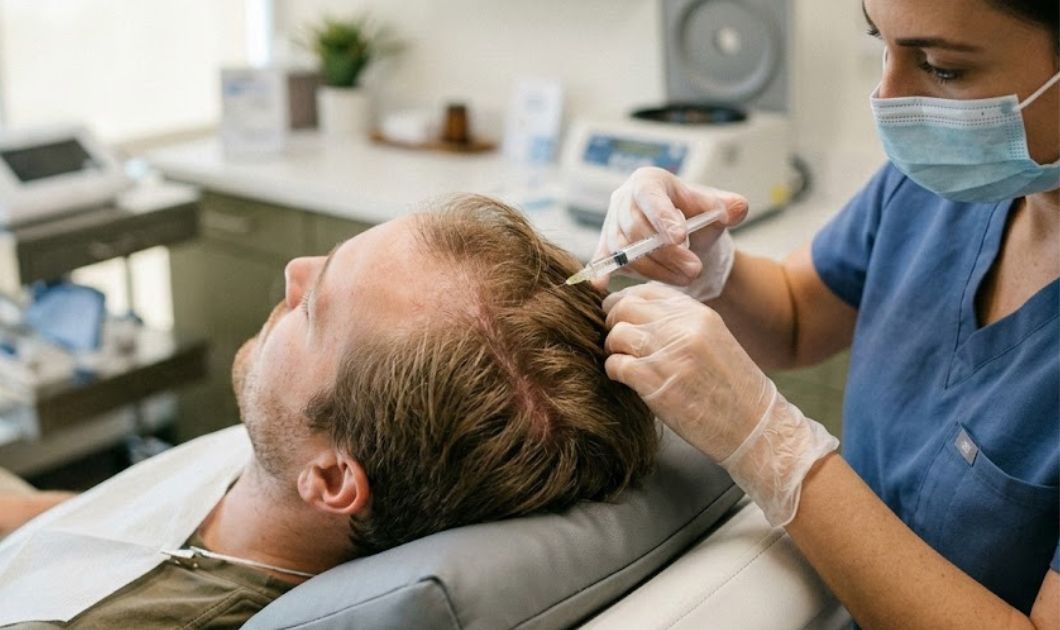
PRP (Platelet-Rich Plasma) is made by taking a small amount of blood from your arm, usually about 10 cc. The blood is then placed in a machine called a centrifuge, which separates it into different parts.
- This process separates the blood, and only the platelet-rich plasma is collected, which is rich in natural growth factors.
- These growth factors help repair tissues, improve blood flow, and support healthy hair growth.
- PRP is injected into thinning areas of the scalp to stimulate hair follicles and encourage natural hair regrowth.
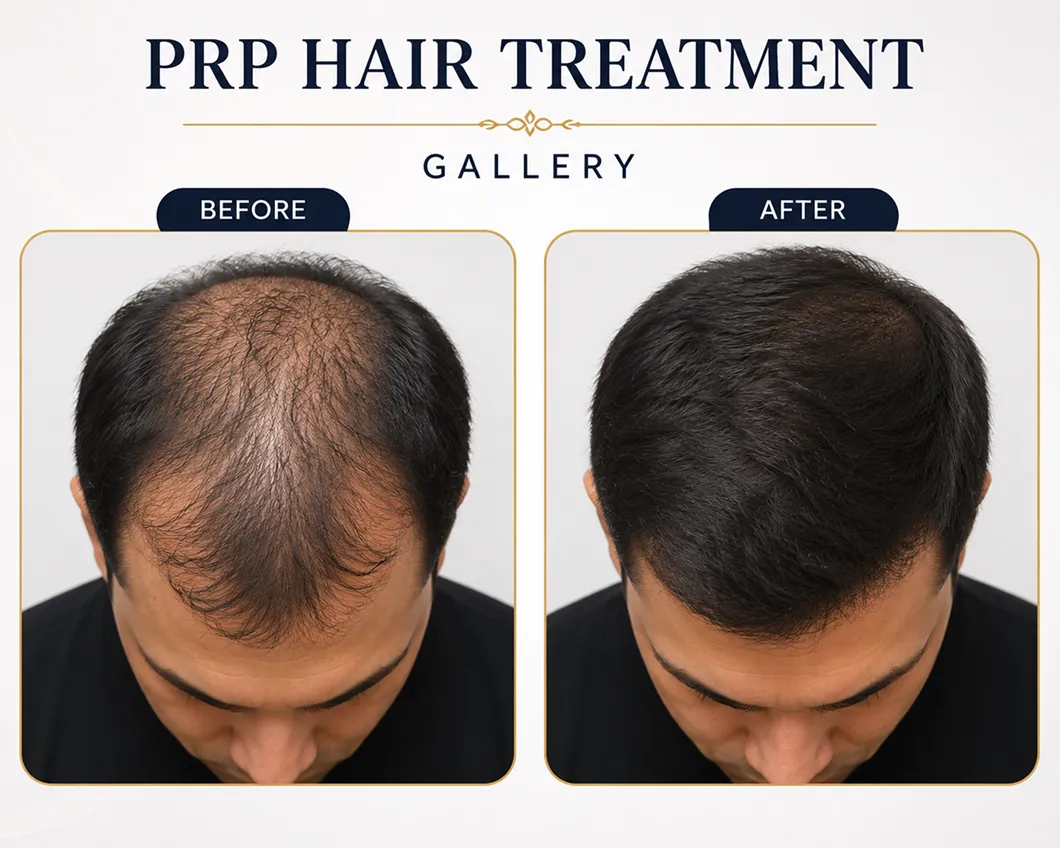
PRP Hair Treatment Before and After: What Does the Timeline Actually Look Like?
Timeline | What Patients Typically Notice |
Weeks 1–4 (after first session) | Scalp feels slightly tender at the injection site. No visible changes yet. This is normal. |
Weeks 4–8 | Reduced shedding is often the first sign. Some patients notice hair feels slightly thicker in texture. |
Months 2–3 | New fine hairs begin emerging along the hairline and crown. Hair thinning slows noticeably. |
Months 3–6 | The most visible improvement phase. Existing hair becomes denser and new growth fills in gaps. |
Months 6–12 | Results continue to mature. Peak density is typically visible 6–12 months post treatment. |
Beyond 12 months | Maintenance sessions preserve the results. Without them, gradual regression may occur. |

Is 3 Sessions of PRP Enough for Real Results?
Three sessions is the minimum recommended protocol for most people with mild to moderate hair loss. Clinical guidelines and the studies referenced in PubMed consistently suggest that three monthly sessions followed by quarterly maintenance produce the strongest outcomes.
However, three sessions alone are rarely the endpoint. Think of the first three as the induction phase. Your scalp needs repeated exposure to growth factors to rebuild follicle activity at a cellular level. For patients with moderate to advanced hair thinning, four to six sessions spaced three to four weeks apart often produce noticeably better before and after results.
The type of hair loss matters too. Androgenetic alopecia (genetic pattern baldness), which is the most common type, responds well to PRP when treated early.
What Are the Key Benefits of PRP Hair Treatment?
Benefit | Detail |
Non-surgical | No incisions, no stitches, no general anaesthetic |
Uses your own blood | Zero risk of allergic reaction or rejection |
Stimulates hair growth naturally | Growth factors reactivate dormant follicles without synthetic hormones |
Minimal downtime | Most patients return to work the same day |
Works for men and women | Effective across different types of hair loss including female pattern baldness |
Complements hair transplant | Often used alongside FUE to improve graft survival and density |
Improves scalp health | Increased blood supply strengthens the overall follicle environment |
What Is the Success Rate of PRP for Hair Regrowth?
PRP therapy for hair loss has been studied in several medical research papers, including those published in the NIH database.
Research shows that PRP can improve hair count and hair density in many patients with androgenetic alopecia (pattern hair loss). On average, about 70–80% of patients who complete a full treatment course see visible improvement.
Success varies by several factors:
- Age: younger patients with active follicles typically respond faster
- Severity of hair loss: mild to moderate thinning shows the strongest before and after improvements
- Underlying cause: hormonal or stress-related hair loss often resolves better than purely genetic hair loss
- Session frequency: patients who complete the full protocol consistently outperform those who skip sessions
- Platelet concentration: higher-quality centrifuge systems and properly prepared PRP yield better growth factor counts
In Trusta Medical Center, we assess each patient individually before designing a PRP program. The goal is not to run everyone through the same protocol, but to match the frequency and concentration to the clinical picture.
PRP vs Hair Transplant: Which One Do You Actually Need?
This is one of the most common questions we receive. The short answer: PRP and hair transplant serve different purposes, and many patients benefit from both.
- PRP and hair transplant are different treatments, and many patients may need one or both.
- PRP strengthens existing hair and improves thinning areas, but it cannot create new hair follicles.
- Hair transplant moves healthy hair follicles to bald areas to create new hair growth where follicles are lost.
- PRP is often used before and after a hair transplant to support healing and improve results.
- PRP is best for early hair loss, while hair transplant is better for visible bald areas.
PRP Hair Treatment Price in Dubai: What Should You Expect to Pay?
PRP hair treatment price in Dubai varies depending on the clinic, the quality of the centrifuge system used, and the number of sessions included in the package. Here is a general range to orient your research:
Session Package | Approximate Price Range (AED) |
Single session | AED 800 – AED 1,500 |
3-session course (recommended minimum) | AED 2,200 – AED 4,000 |
6-session course (optimal for moderate loss) | AED 4,000 – AED 7,500 |
PRP combined with hair transplant protocol | Package pricing applies |
Price alone should not drive the decision. The quality of PRP depends significantly on how the blood is processed. A clinic using a single-spin centrifuge at low RPM produces a very different platelet concentration than one using a double-spin protocol with calibrated tubes. Ask the clinic specifically about their platelet concentration targets and preparation method before committing.
How Long Does PRP Hair Treatment Last?
Results from a full PRP course typically last 12 to 18 months before the effects begin to diminish. This does not mean all progress is lost at that point. Rather, the follicles gradually return to their pre-treatment state without ongoing stimulation. Factors that affect how long results last include:
- Genetics: patients with strong hereditary hair loss may need more frequent maintenance
- Lifestyle: poor nutrition, chronic stress, and disrupted sleep accelerate follicle regression
- Scalp health: regular conditioning treatments and avoiding harsh chemical processing help sustain results
- Underlying hormonal balance: unmanaged conditions like thyroid dysfunction or PCOS can shorten result duration
Can I Eat Eggs After PRP? Post-Treatment Diet and Care
Yes, eggs are completely fine after PRP treatment. In fact, they are actively beneficial. Eggs are rich in biotin, protein, and zinc, all of which support healthy hair growth and follicle repair. The post-treatment recovery guidelines are generally more about what to avoid than what you must restrict.
What to Avoid in the 48–72 Hours After PRP Injections
- Alcohol: it dilates blood vessels and can increase injection site bruising
- Anti-inflammatory medications like ibuprofen: these can reduce platelet activity, which counteracts the treatment
- Intense exercise: heavy sweating and elevated heart rate in the first 24 hours can disperse the PRP before it settles
- Swimming pools and saunas: chlorine and heat exposure can irritate the scalp at the injection site
- Hair colouring or chemical treatments: leave at least one week before any chemical processing
What Supports Your Results
- High-protein diet including eggs, legumes, lean meats, and dairy
- Iron-rich foods if deficiency is a contributing factor to your hair loss
- Staying well hydrated to support scalp circulation
- Gentle scalp massage two to three days after treatment to improve blood flow
Are There Side Effects from PRP Hair Treatment?
Because PRP uses your own blood, the side effects profile is generally mild. The most common experiences include:
- Mild tenderness or sensitivity at the injection site for 24–48 hours
- Temporary redness or swelling on the scalp immediately after the session
- Occasional light bruising, particularly in patients who are prone to bruising
- A tight or heavy sensation in the scalp for the first day
Serious adverse reactions are rare. Because there is no foreign substance introduced, allergic reactions are essentially eliminated as a risk. The procedure does not interfere with other medications in most cases, though you should inform your clinician about any blood thinners or supplements you are taking.
Patients with active scalp infections, platelet dysfunction disorders, or certain blood conditions are not suitable candidates. A consultation allows us to screen for these and determine whether PRP therapy is appropriate for you.
Who Gets the Best Results from PRP for Hair Loss?
PRP works best for a specific group of patients. You are likely a strong candidate if:
- You are in the early to moderate stages of androgenetic alopecia or pattern hair loss
- You have visible thinning but still have active follicles in the affected areas
- You experience telogen effluvium (diffuse shedding) related to stress, postpartum changes, or nutritional shifts
- You have female pattern baldness and want a non-hormonal treatment option
- You recently had a hair transplant and want to improve graft survival
- You want to slow progression before committing to a surgical option
PRP is less likely to produce visible results if the area is completely smooth with no remaining follicular activity, or if a systemic condition like active autoimmune disease is driving the hair loss.
Combining PRP with Hair Transplant in Dubai
One of the most clinically sound approaches for patients with significant hair loss is combining PRP injections with an FUE hair transplant. The growth factors in PRP improve graft survival by supporting the blood supply around newly implanted follicles during the critical healing window.
Many surgeons recommend a session of PRP two to four weeks before transplant surgery to prepare the scalp, followed by a session one to two months after to enhance healing and density. In Trusta Medical Center, this combined approach forms part of our comprehensive hair restoration programme for patients who qualify.
You can learn more about our hair transplant programme and how it integrates with PRP on our dedicated hair transplant page. For patients with beard or eyebrow thinning, we also offer beard transplant and eyebrow transplant services that can be paired with PRP therapy.
The Science Behind PRP: What the Research Shows
The clinical evidence for PRP in androgenetic alopecia has grown substantially over the past decade. Research indexed on PubMed Central (PMC) demonstrates that platelet-rich plasma PRP therapy produces statistically significant improvements in hair density, follicular diameter, and telogen to anagen ratio in patients completing three or more sessions.
A systematic review and meta-analysis available via the National Center for Biotechnology Information (NCBI/NIH) concluded that PRP injection is a safe, well-tolerated, and effective treatment for androgenetic alopecia, particularly when delivered in standardised multi-session protocols.
PRP Hair Treatment Gallery

Frequently Asked Questions
How long do PRP results last for hair?
Results from a completed PRP course typically last 12 to 18 months. After that, a single maintenance session every 6 to 12 months helps sustain the improvement.
Is 3 sessions of PRP enough?
Three sessions is the recommended minimum and works well for patients with early-stage hair loss. Moderate to advanced thinning generally benefits from four to six sessions over the initial treatment period.
Can I eat eggs after PRP?
Yes. Eggs are encouraged as part of post-PRP nutrition because they contain biotin, protein, and zinc that support hair follicle health. The main restrictions involve alcohol, NSAIDs, and intense physical activity in the first 48 to 72 hours.
What is the success rate of PRP for hair regrowth?
Clinical studies show meaningful improvement in roughly 70 to 80 percent of patients with androgenetic alopecia who complete a full protocol. Success rates are highest in patients with mild to moderate hair loss who start treatment before widespread follicle miniaturisation occurs.
How does PRP compare to other hair loss treatments?
Unlike topical treatments such as minoxidil or oral medications like finasteride, PRP works biologically by stimulating the follicle itself. It does not require daily application or carry the systemic side effect profile of hormone-modulating drugs. PRP also works alongside a hair transplant in ways that most topical treatments cannot.