
October 29, 2026
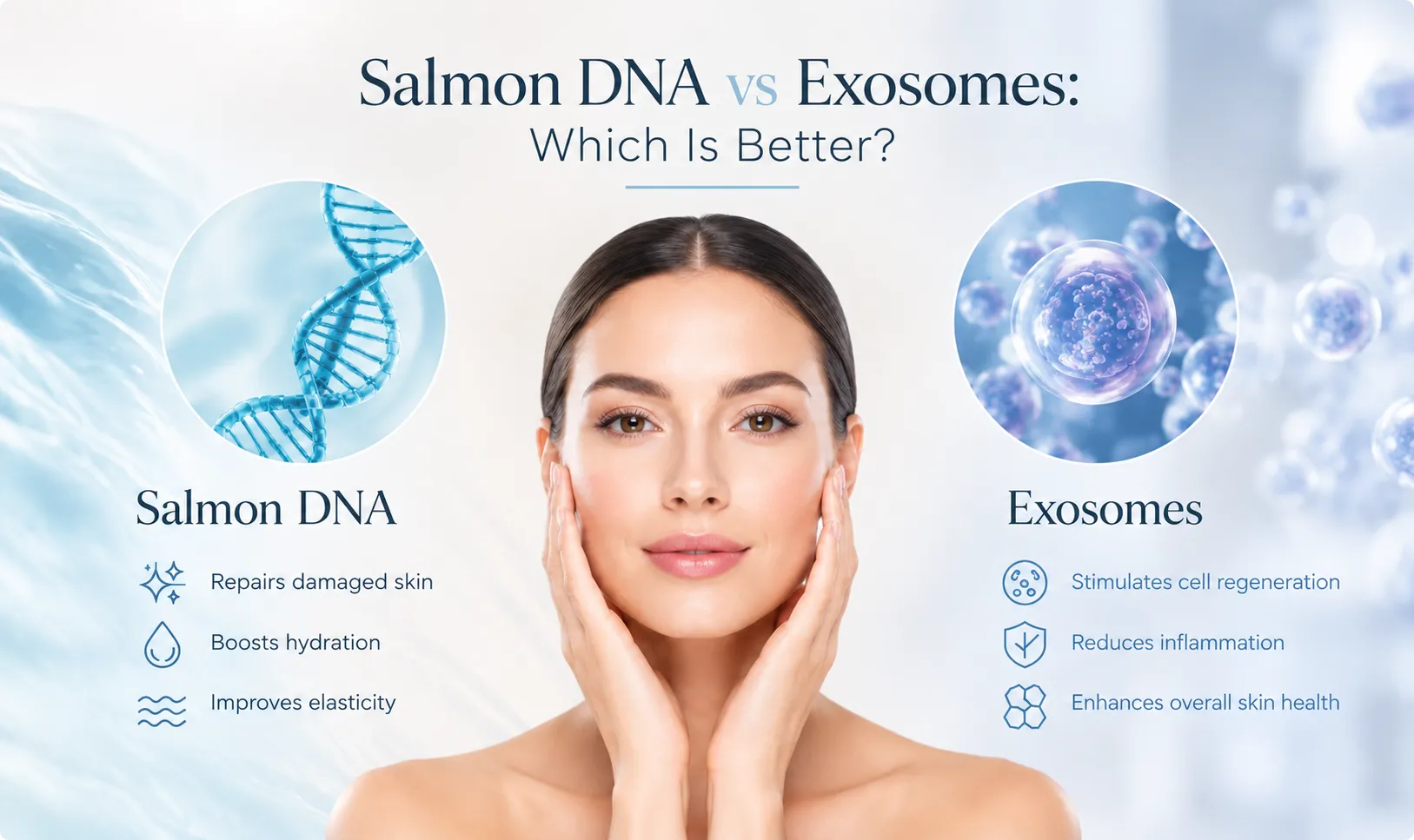
Salmon DNA vs Exosomes is an important comparison for people exploring skin rejuvenation and regenerative aesthetic treatments. Both approaches are discussed for their potential role in supporting skin quality; however, they differ in their composition, mechanisms, available clinical evidence, and suitability for individual skin concerns. Understanding these differences can help you make a more informed decision with guidance from a qualified skincare professional.
Salmon DNA vs exosomes differ in their way of working on skin cells.
Salmon DNA products usually contain PDRN or other polynucleotides, while exosome-based products contain extracellular vesicles that carry cellular signals.Neither treatment has proven superiority over the other.
It all comes down to your personal preference.
What Is Salmon DNA Treatment?
Salmon DNA is most often understood in terms of cosmetic substances, usually made up of PDRN and polynucleotides (PN) – DNA derivatives, derived from salmon or trout.
These substances have attracted scientific interest because of their potential roles in tissue regeneration, inflammation control, and skin rejuvenation.
Researchers have studied PDRN for its involvement in cellular repair and wound healing. In aesthetic medicine, practitioners also use certain polynucleotide formulations to improve skin quality and appearance.
Potential Benefits of Salmon DNA Treatment
Based on the formulation and treatment procedure, some of the conditions that might benefit from salmon DNA-based treatments include:
- Skin texture: Enhancing the appearance of skin that is rough or uneven in texture.
- Moisture: The use of some polynucleotide formulations can enhance skin hydration.
- Elasticity: May result in alteration of skin elasticity and firmness.
- Wound healing: PDRN has been used in studies on wound healing and tissue regeneration.
- Rejuvenation: The use of some formulations to tackle signs of aging skin.
The results will depend on the specific product, mode of application, and the skin condition of an individual. The findings regarding one PDRN formulation cannot automatically apply to all products under the name salmon DNA.
What Are Exosomes in Skin Regeneration Treatments?
Exosomes are small vesicles released by cells. They contain biological molecules, including proteins, lipids, and nucleic acids, that help cells communicate with one another.
In the field of dermatology, the potential of exosomes in inflammatory regulation, tissue repair, skin pigmentation, collagen production, and hair growth has been investigated. The possible application of exosomes has led to their use in skin rejuvenation.
There is significant variation regarding exosomes’ preparations. There are variations in biological origin, preparation, purity, content, and administration of exosome preparations.
Potential Benefits of Exosome-Based Treatments
In relation to product type and use, research possibilities are:
texture: Preliminary studies indicate that there may be benefits to skin texture appearance.
- Skin recovery: There are studies examining exosomes’ involvement in tissue healing procedures.
- Rejuvenation: There are studies looking at their impact on the appearance of aged skin.
- Pigmentation: There have been some studies looking at how exosomes affect pigmentation.
- Hair and scalp: Studies are being conducted in relation to hair problems using exosomes.
Many of these studies are still in preliminary stages. Promising lab results do not always mean that a treatment works and is safe for practical purposes.
Salmon DNA vs Exosomes: Key Differences
Although researchers study both salmon DNA and exosomes in regenerative aesthetics, the two differ in their biological composition, mechanisms of action, research history, and potential applications.
Source and Biology
Salmon DNA, also known as PN/PDRN, refers to DNA-derived materials extracted from fish such as salmon and trout. Researchers study DNA and polynucleotides to understand their effects on skin regeneration, inflammation, and overall skin quality. On the other hand, exosomes are vesicles in nature and can be sourced from various biological origins.
Potential Skin Benefits
The use of salmon DNA therapies has been employed in aesthetic cases where there is need for enhancement of the skin’s appearance, hydration, and healing capacity. There have been studies involving exosomes that seek to improve skin rejuvenation and healing properties. But again, the results may vary based on formulation and mode of treatment among other factors.
Clinical Evidence and Research
Clinical trials exist for some salmon DNA formulations but the quality of the evidence is variable. Many exosome applications for aesthetic use still exist only in preliminary research and require additional clinical trials to determine their efficacy and safety. It is important that the evidence be evaluated for its applicability to the particular formulation and use rather than generalizing all exosome formulations as one group.A review published in PubMed discusses the potential applications of exosomes in aesthetic dermatology and highlights the need for further clinical research to establish their effectiveness and safety.
Product Quality and Safety Considerations
The effectiveness of the DNA-based therapy in the salmon is affected by many factors including the composition, purity, and molecular characteristics of the substance. In the case of exosomes, the biological source, as well as the methods of its extraction and purification, are essential to take into account. For both techniques, the safety factor is the issue that is determined by the type of the drug and the delivery method.
Which Is the Main Difference?
Salmon DNA provides DNA-based materials, while exosomes act as biological carriers that transport cellular molecules. Although researchers investigate both approaches in regenerative aesthetics, they differ in composition, mechanisms of action, and the strength of available clinical evidence. The selection among the two depends on the skin issue at hand and professional guidance.

Salmon DNA VS EXOSOMES: Which Is More Effective?
The comparison of PDRN vs exosomes requires looking beyond marketing claims. Both have attracted scientific interest, but the strength of the evidence differs across products and treatment goals.
1. For Skin Texture and Hydration
PDRN and polynucleotide-based therapies have been studied for their benefits in terms of skin quality, such as skin texture and hydration.
Some exosome-based products have also yielded positive results in preliminary research. Nonetheless, there are no high-quality head-to-head studies that could help make a decision on which therapy works better.
2. For Skin Repair and Recovery
Researchers have studied PDRN for its role in tissue repair and wound healing. Similarly, scientists have investigated exosomes to understand their involvement in cell communication and tissue repair processes.
The scientific basis for either therapy depends upon the indication and product itself. Researchers should not treat evidence from wound-healing studies as conclusive proof of the effectiveness of skin rejuvenation treatments.
3. For Long-Term Safety
Data regarding long-term safety continue to be scarce for both therapies in many aesthetic uses. In addition, there are further issues with exosome products, which vary significantly in terms of their composition and production.
It is recommended that a healthcare practitioner evaluate all these factors prior to treatment.
Which Skin Concerns May Influence Your Choice? Salmon DNA VS EXOSOMES
Choosing between salmon DNA and exosomes starts with identifying the concern you want to address. The appropriate approach depends on the specific skin condition, as neither method offers a universal solution for every skin concern.
- Dull and dry skin: Decide if the polynucleotide therapy or any other skin quality procedure would be applicable in the specific case.
- Uneven Skin Texture: Identify the underlying cause, such as dehydration, acne scars, enlarged pores, or other skin concerns.
- Aging symptoms: Take into account such aspects as skin elasticity, presence of fine lines, UV exposure, general state of the skin.
- Pigmentation: A proper diagnosis helps identify the cause of pigmentation, such as melasma, post-inflammatory hyperpigmentation, or sunspots.
- Healing Problems: Check whether scientific evidence supports the product’s safety and effectiveness for the specific condition.
People can talk about their skin-related problems as well as cosmetic goals at Trusta Medical Center located in Downtown Dubai.
What Factors Affect Treatment Results?
The effectiveness of skin regeneration treatment depends on other aspects apart from the active component. Please, pay attention to the following matters before making any comparisons between the products:
Formulation of the product
Ingredients, concentration, purity, and manufacturing process might affect the properties of the product.
Application method
Topical application, delivery with the help of microneedling, and injection are different types of delivery which cannot be compared since efficacy and safety of one type of delivery do not guarantee the efficacy and safety of another.
State of individual skin
Age, sensitivity of the skin, presence of skin diseases, exposure to sunlight, and general health might affect the course and results of treatment.
Regimen
Some treatments are rather complicated and include several procedures; however, the regimen varies depending on the choice of the product and individual health conditions. There is no standard regimen for any salmon DNA or exosomes therapy.
Evidence quality
Publishing the information in scientific journals, safety data for a certain product, and official authorization are more significant than unproven claims about skin regeneration and collagen production.
Are Salmon DNA and Exosomes Safe?
However, the specific product, administration method, practitioner’s qualifications, and patient’s overall health determine the safety of the treatment.
Some of the potential side effects after any form of injection or treatment with the help of some procedure are redness, swelling, soreness, bruising, or irritation. However, there may be more severe adverse effects with invasive procedures.
Before choosing either treatment, consider these precautions:
- Check product’s quality: Know the source of the product, the content, sterility, and quality control of the product.
- Verify product’s authorization: Verify whether the product along with its function is authorized by the concerned authority.
- Medical history disclosure: Share relevant information about allergies, medication, dermatological problems, and any previous medical procedure performed.
- Method of administering: The injectable and topical products come with different risks and therefore cannot be expected to have the same impacts.
- Requirement of evidence: Find out more about the research behind the scientific rationale for the proposed treatment and limitations attached.
Aesthetic treatments based on exosomes are still under investigation in many cases, and therefore no authorization can ever be assumed. Similarly, the proof of efficacy of PDRN for a specific medical procedure cannot be an assumption for all the cosmetic procedures.
How Should You Prepare for a Consultation?
Through consultation, you will get acquainted with how suitable a certain therapy would be for your case.
- Your main concerns and objectives regarding your skin.
- The list of all the medicines, allergic reactions, and illnesses.
- Previous experience with aesthetic procedures and their results.
- Questions concerning the origins of the procedure, proof of its effectiveness, safety, etc.
- Recovery time and side effects to be expected.
The discussion of this information with an experienced medical specialist will give you the chance to make an informed choice of aesthetic treatments in Trusta Medical Centre
Frequently Asked Questions
Is salmon DNA a better option than exosomes?
It would be incorrect to call one of them better than the other. There are differences in biological processes for salmon DNA preparations and exosomes; both treatments work under different conditions.
What is the difference between PDRN vs exosomes?
PDRN refers to DNA fragments being researched for its effects in the repair of tissues and other biological functions. On the other hand, exosomes refer to extracellular vesicles that transport biological material from one cell to another.
How long do salmon DNA treatment results last?
The effects depend on the nature of the product, method of administration, frequency of administration, and patient’s skin characteristics. There is no general period of time as the long-term results are not well-studied for most cosmetic purposes.
Are exosome treatments FDA-approved for skin rejuvenation?
This depends on the nature of the product itself. FDA approval cannot be automatically inferred for exosomes for cosmetic skin rejuvenation. It would also be a good idea for Dubai patients to confirm that their chosen product is legal and can be used within UAE.
Can salmon DNA vs exosomes be used together?
Some of the treatments contain regenerative substances but just because they contain the above-mentioned substances does not mean that the effects will be better and safer. The appropriate evaluation of the products and possible risks should be done by the qualified clinician.
Which treatment is more suitable for sensitive skin?
There is no general answer to this question since there are different substances that may cause allergic reactions to sensitive skin. Therefore, the skin condition, product contents, and risks should be assessed by the clinician.
Conclusion
The comparison of salmon DNA vs exosomes helps in evaluating two different approaches to skin rejuvenation. Researchers have assessed DNA-based products, such as PDRN and polynucleotides, to determine their ability to promote wound healing and improve skin condition. Researchers also investigate how exosomes support cell-to-cell communication and tissue regeneration, while scientists continue to develop various cosmetic applications for these molecules.
Do not base your decision on the popularity of a product and its marketing only; rather pay attention to the product itself, its scientific background and safety along with your needs.
Advice from an expert of Trusta Medical Center can be useful in determining the right direction for your therapy.