
May 12, 2026
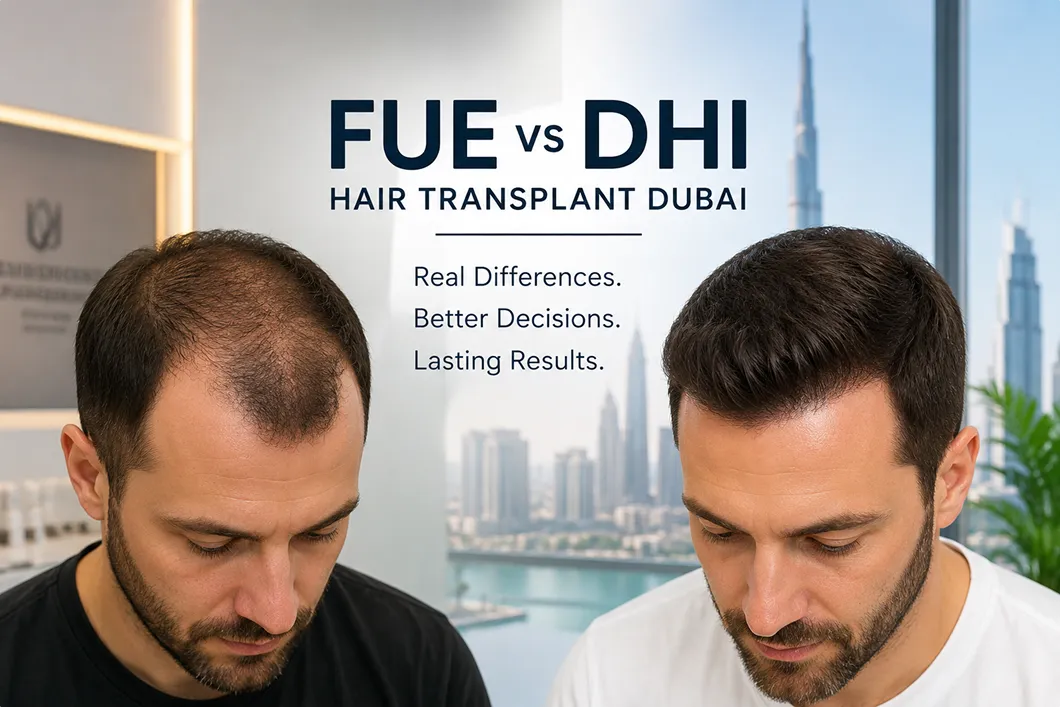
Hair transplant marketing online can make the decision feel far more confusing than it really is. One clinic says DHI is the most advanced technique. Another claims Sapphire FUE gives better density. Some advertise “scar-free” procedures. Others promise unrealistic graft numbers in a single day.
The truth is more nuanced. Neither FUE nor DHI is universally better for every patient. The right technique depends on your pattern of Hair loss, donor quality, scalp characteristics, density goals, lifestyle, and, most importantly the skill of the surgical team performing the procedure.
If you are searching for a Hair transplant clinic in Dubai or comparing options near Downtown Dubai, Jumeirah, Business Bay, or Sheikh Zayed Road, this guide will help you understand what genuinely matters clinically not just what sounds impressive in advertisements.
Understanding Modern Hair Transplant Techniques
Modern Hair transplantation has evolved dramatically. Older FUT strip surgery often left a visible linear scar and longer recovery periods. Today, most premium Hair restoration Dubai providers primarily perform minimally invasive follicular unit procedures such as FUE, DHI, and Sapphire FUE.
The goal is no longer simply moving hair. The focus is creating natural density, preserving donor hair intelligently, and designing a hairline that still looks believable years later.
What Are Follicular Units?
- Hair does not grow as single strands naturally.
- It grows in tiny anatomical groups called follicular units.
- These units usually contain 1, 2, 3, or sometimes 4 hairs.
- Modern surgery preserves these natural groupings during extraction and implantation.
The Donor Area Concept
- The donor area is usually located at the back and sides of the scalp.
- These follicles are genetically resistant to DHT-related hair loss.
- Donor hair is limited, making donor management critical for long-term planning.
- Poor clinics may overharvest grafts, thinning the donor area permanently.
What Is FUE Hair Transplant?
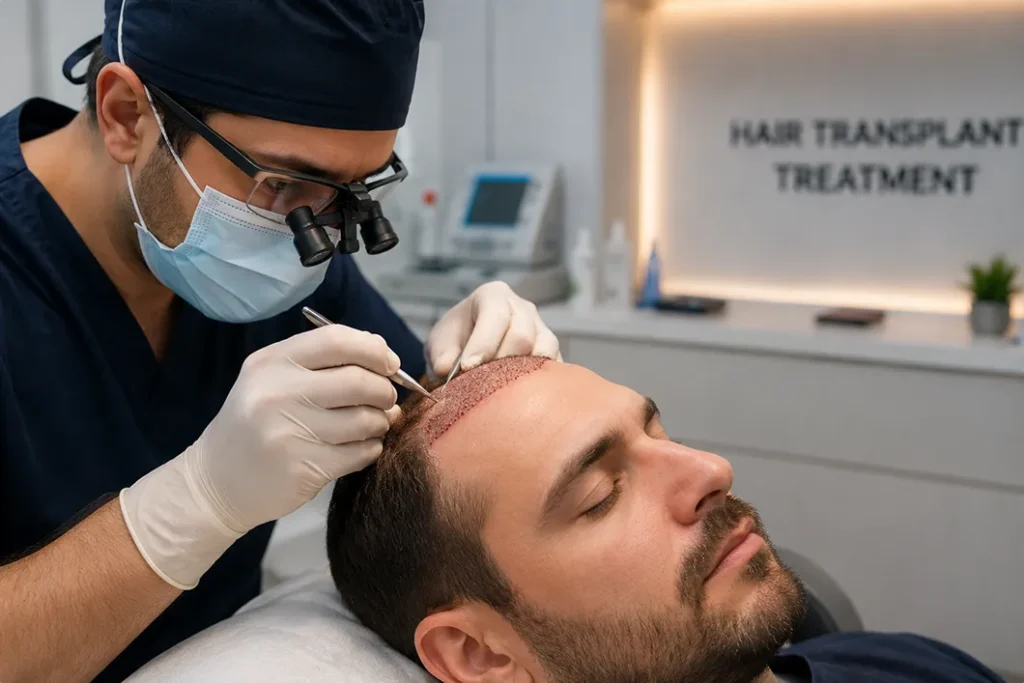
FUE (Follicular Unit Extraction) is the foundation of most modern hair restoration. It involves extracting individual follicular units directly from the donor area using a micro-punch tool.
The FUE Process
- Preparation: The donor area is typically trimmed or shaved. Local anesthesia is applied for comfort.
- Extraction: Individual grafts are removed using micro-punch tools (0.7 mm to 1.0 mm).
- Channel Creation: The surgeon creates tiny recipient channels in the thinning area using a steel or Sapphire blade.
- Implantation: Grafts are manually placed into these pre-created channels.
Why FUE Works for Larger Bald Areas
- Scalability: Excellent for Norwood 4–7 hair loss where high graft counts (3,500+) are needed.
- Efficiency: Allows for faster coverage of large surface areas in a single session.
- Cost-Effective: Generally more affordable than DHI for extensive restoration.
What Is DHI Hair Transplant?
DHI (Direct Hair Implantation) is often marketed as a separate method, but technically, it is a variation of FUE. It uses the same extraction process but a different implantation method.
The Choi Implanter Pen
In DHI, the surgeon uses a specialized tool called a Choi Implanter Pen. This device allows the surgeon to create the recipient channel and implant the graft simultaneously.
Key Advantages of DHI
- Reduced Graft Handling: Grafts spend less time outside the body (reduced ischemia time).
- Extreme Precision: The Choi pen gives the surgeon minute control over the implantation angle, depth, and direction.
- No-Shave Possibilities: Often preferred for patients (including women) who wish to keep their existing hair long during the procedure.
Frontal Hairline Artistry: Ideal for the “dense packing” required for a natural-looking hairline.
FUE vs DHI: The Real Technical Differences
Factor | DHI Advantage | FUE / Sapphire FUE Advantage |
Implantation | Direct (Simultaneous) | Pre-created Channels |
Precision | Better for frontal hairline / angle control | High overall |
Coverage | Best for small/medium areas (1,500-2,500) | Best for large areas (up to 5,000) |
Shaving | Often avoidable (Unshaven) | Usually required |
Procedure Time | Slower (More labor intensive) | Faster extraction and placement |
Cost in Dubai | Typically higher | More cost-efficient for high graft counts |
Recovery | Often faster healing / less scabbing | Fast (10-14 days for social appearance) |
DHI vs Sapphire FUE: Which Is Better?
Most competitors cover this weakly. Sapphire FUE is often confused with DHI, but they solve different problems.
- Sapphire FUE uses blades made from synthetic sapphire to create cleaner, smaller recipient channels. This reduces tissue trauma and shock loss while allowing for high-density placement in large areas.
- DHI bypasses the separate channel-creation step entirely by using the Choi pen.
The Verdict: Sapphire FUE is often superior for patients needing massive coverage (4,000+ grafts) with faster surgical efficiency. DHI is the gold standard for hairline restoration and filling in diffuse thinning without a full shave.
Recovery and Healing: What to Honestly Expect
Many patients ask: “Would I look normal after 10 days?”
- Days 1–3: Mild redness, swelling, and tenderness. You must sleep elevated.
- Days 5–10: Small scabs begin to shed. Most patients are socially presentable by day 10.
- Weeks 2–8: Shock loss occurs where transplanted hairs fall out. This is normal; the follicles remain healthy.
- Months 4–12: New growth appears. Final density is usually achieved by 12–15 months.
DHI vs FUE Cost in Dubai
Pricing for a Hair transplant in Dubai is rarely a flat fee. It is calculated based on technique and the number of follicles moved.
Cost by Technique (Estimates)
- FUE: AED 8,000 – 20,000+
- DHI: AED 12,000 – 30,000+
- Sapphire FUE: AED 10,000 – 25,000+
Cost by Graft Count
- 2,000 Grafts: AED 10,000 – 16,000 (Moderate thinning)
- 3,000 Grafts: AED 15,000 – 24,000 (Extensive coverage)
- 4,000+ Grafts: AED 20,000 – 32,000+ (Advanced baldness)
Can DHI and FUE Be Combined?
This is a strong differentiator that most budget clinics won’t offer. A Hybrid FUE approach uses:
- Sapphire FUE to cover the large “bulk” areas like the crown or mid-scalp efficiently.
- DHI to refine the frontal hairline where maximum precision and angle control are required.
Thispersonalized planning ensures you don’t overpay for DHI where it isn’t needed, while still getting the best possible aesthetic result for your face.
Why Patients Choose Trusta Clinic for Hair Restoration
Located conveniently near Downtown Dubai and Business Bay, we prioritize medical honesty over marketing labels.
- Surgeon-Led: Our doctors are involved in the entire process, not just the consultation.
- Microscopic Graft Handling: Every follicular unit is inspected to ensure maximum viability.
- PRP Integration: We often combine surgery with PRP therapy to accelerate the healing of the scalp and promote graft survival.
- Natural Hairline Philosophy: We don’t design “straight lines.” We mimic natural irregularity to ensure your transplant remains undetectable.
Frequently Asked Questions
Is DHI better than FUE?
Neither is “better.” DHI is superior for hairline precision and unshaven sessions; FUE is better for covering large bald areas cost-effectively.
Does DHI heal faster?
Generally, yes. Because DHI involves less overall scalp trauma (no pre-incisions), scabbing and redness often resolve a few days sooner.
Is 3,000 grafts enough?
For moderate hair loss (receding hairline and some thinning), 3,000 grafts provide excellent coverage. Advanced baldness may require 4,500+.
Which method leaves fewer scars?
Both leave tiny “dot” scars in the donor area. These are virtually invisible even with short hair. FUT is the only method that leaves a linear scar.
Is hair transplant permanent?
Yes. Follicles taken from the “permanent” donor zone retain their genetic resistance to hair loss even after being moved.