
May 19, 2026
Choosing between FUE and FUT is one of the most common questions patients ask during their hair transplant consultation in Dubai. In this guide to FUE vs FUT Hair Transplant Dubai, we explain how both techniques deliver permanent results while offering different advantages based on your hair loss pattern, donor area, lifestyle, and expectations.
In Trusta Clinic, our DHA-licensed surgeons perform FUE, FUT, and DHI hair transplant procedures with a personalized approach to ensure natural-looking results. This page provides an honest, medically accurate comparison of each technique so you can attend your consultation informed, confident, and ready to choose the right solution for your goals.
Looking for a complete guide to hair restoration treatments? Explore our Hair Restoration Dubai pillar page to learn about procedures, recovery, costs, and expert care options at Trusta Clinic.
Understanding the Three Main Hair Transplant Techniques
What Is FUE (Follicular Unit Extraction)?
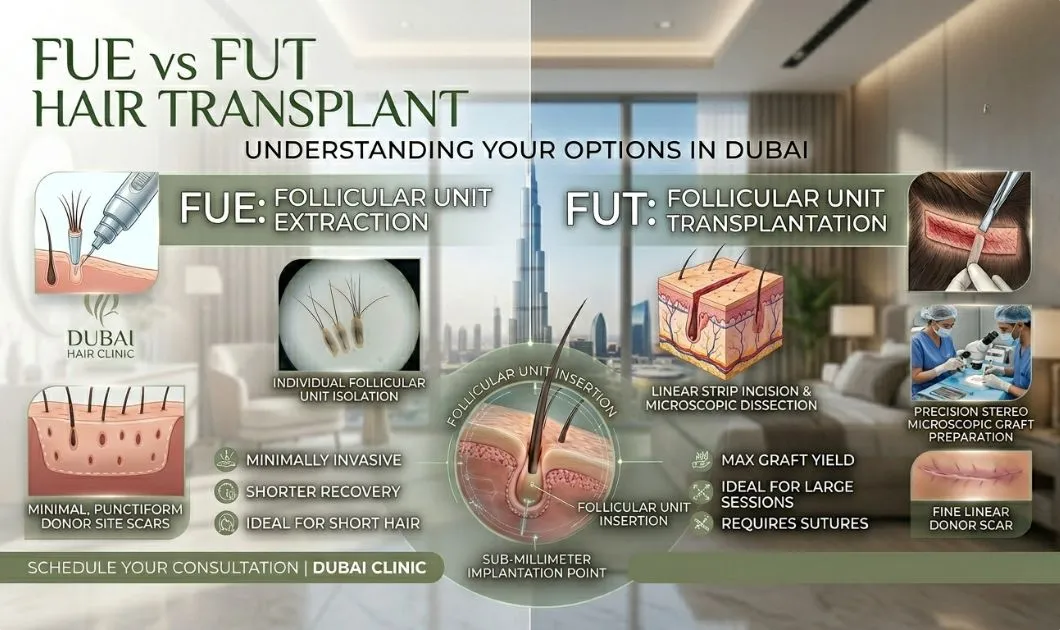
Follicular Unit Extraction is a minimally invasive hair transplant technique in which individual follicular units of naturally occurring groups of 1–4 hairs are extracted one by one from the donor area using a hollow micro-punch tool, typically between 0.6mm and 1.0mm in diameter. These grafts are then implanted into the thinning or balding areas through precisely angled micro-channels.
Because FUE removes follicles individually rather than as a strip, there is no linear scar. The extraction sites heal as tiny circular dots that are virtually undetectable even with a shaved head. Recovery is faster than FUT, and patients typically return to desk work within 3–5 days.
What Is FUT (Follicular Unit Transplantation)?
Follicular Unit Transplantation, also called the strip method involves surgically removing a thin horizontal strip of scalp tissue from the donor area, typically at the back of the head. This strip is then divided by trained technicians under stereo-microscopes into individual follicular units, which are transplanted into the recipient areas.
FUT leaves a linear scar along the donor site, which is concealed within the surrounding hair at normal lengths. However, FUT allows for the harvesting of a greater number of grafts per session compared to standard FUE, making it particularly suitable for patients who need large coverage in a single procedure. Graft survival rates with FUT are also excellent because follicular units are dissected under magnification with minimal transection.
What Is DHI — and Where Does It Fit?
Direct Hair Implantation (DHI) is a refinement of the FUE extraction process. The key difference lies in the implantation step: rather than creating recipient channels first and then inserting grafts, DHI uses a pen-like Choi implant device to simultaneously create the channel and insert the graft in one motion.
This approach offers superior control over implantation angle, direction, and depth making it particularly effective for hairline reconstruction and cases requiring very high density. DHI can also be performed with minimal or no shaving of the recipient area in some cases, which is preferred by some patients.
FUE vs FUT – Complete Side-by-Side Comparison
Factor | FUE | FUT |
Scarring | Tiny circular dot scars (easily concealed) | Single linear scar (concealed by hair) |
Grafts per session | 1,000–3,500+ | 1,500–4,500+ |
Best for | Short styles, limited area, first-time patients | Large coverage needs, maximum graft yield |
Recovery time | 7–10 days | 10–14 days |
Return to work | Day 3–5 | Day 7–10 |
Pain level | Minimal | Moderate (donor site) |
Donor area shaving | Usually required | Not required at extraction site |
Graft survival rate | 90–95% (technique-dependent) | 95%+ (under microscope dissection) |
Suited for short hairstyles | Yes | Only if scar is fully grown over |
Cost | Higher per graft | Lower per graft (more grafts per session) |
Revision/second session | Possible from same donor area | Possible (combined with FUE) |
FUE Hair Transplant in Dubai – A Closer Look
How the FUE Procedure Works at Trusta Clinic
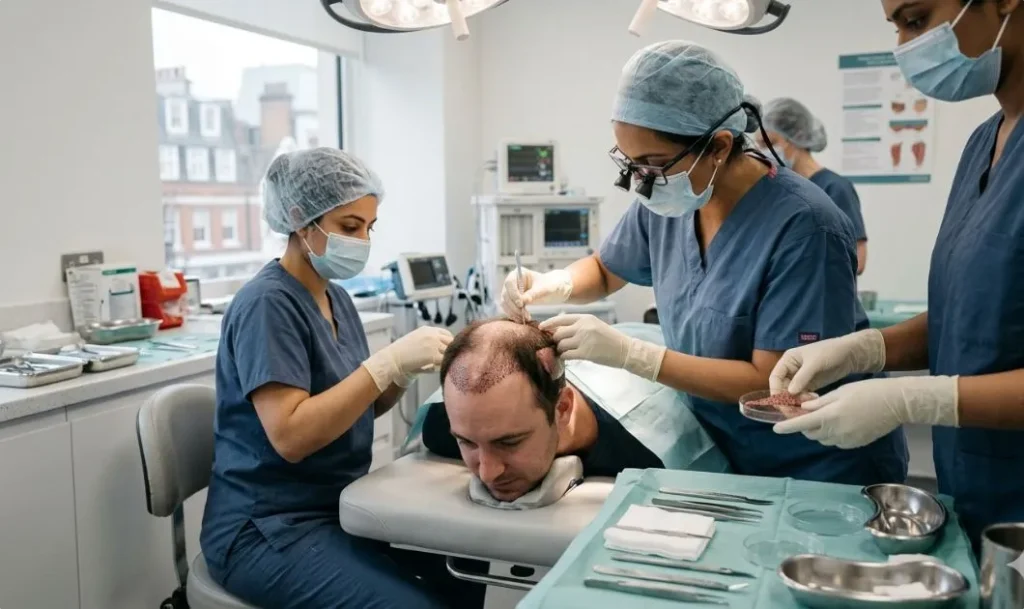
On the day of your procedure, the donor area is shaved and cleaned. Local anaesthesia is administered using a fine needle this is the most uncomfortable part of the process, and it passes within minutes. Your surgeon then uses a motorised punch to systematically extract follicular units from the donor area in a dispersed pattern to prevent visible depletion.
Once sufficient grafts are harvested, they are sorted by the team and kept in a holding solution to maintain viability. Your surgeon then creates recipient channels in the balding area, taking care to mimic the natural angle, direction, and distribution of your original hair. Grafts are then carefully placed into each channel. The entire process typically takes 5–8 hours depending on graft count.
Sapphire FUE vs Standard FUE
Standard FUE uses steel blades to create recipient channels. Sapphire FUE uses blades made from synthetic sapphire crystals, which are harder and more precise than steel. The advantages of Sapphire FUE include:
- Sharper, V-shaped channels that cause less tissue trauma
- Reduced risk of post-operative oedema (swelling)
- Potentially higher graft survival due to improved blood flow in the recipient area
- Denser packing — more grafts per square centimetre — for improved density
In Trusta Clinic, Sapphire FUE is our standard approach for FUE procedures, as we believe the clinical evidence supports superior outcomes.
Advantages of FUE
- No linear scar — safe to wear hair short
- Faster overall recovery
- Can be used for body-to-scalp hair transplants (chest, beard grafts to scalp)
- Suitable for smaller, targeted areas
- Less post-operative discomfort in the donor area
Limitations of FUE
- Larger sessions require longer procedure time
- Donor area must be shaved (except in some DHI cases)
- Higher cost per graft compared to FUT
- May not be optimal if very large numbers of grafts are needed in a single session
FUT Hair Transplant in Dubai — When Strip Is the Right Choice
How FUT Differs From FUE in Practice
In FUT, local anaesthesia is applied along the donor strip area. A thin strip of scalp — typically 1–1.5cm wide and 15–30cm long — is removed and the wound is closed with sutures or staples, leaving a fine linear scar. The strip is then taken to the preparation area, where skilled technicians dissect it into individual follicular units under stereo-microscopes. This process allows for very precise graft preparation with minimal transection (cutting through follicles accidentally).
The prepared grafts are implanted using the same recipient channel technique as FUE.
Who Is the Ideal FUT Candidate?
FUT is particularly well suited for patients who:
- Need a large number of grafts (3,000+) in a single session
- Wear their hair at a length that conceals the linear scar
- Have had a previous FUE procedure and need additional grafts
- Want to maximise graft yield from the donor area
- Are not concerned about wearing their hair very short
DHI Hair Transplant — Precision Without Pre-Made Channels
DHI is an excellent choice for patients prioritising maximum density and precision particularly for hairline work or those who prefer minimal shaving of the recipient area. At Trusta Clinic, we offer DHI for appropriate candidates, and your surgeon will advise whether this technique suits your specific anatomy and goals.
The main trade-off with DHI is procedure time DHI sessions typically take longer than standard FUE due to the one-by-one implantation process, which can affect cost.
Which Technique Does Trusta Clinic Recommend?
There is no single “best” technique the best technique is the one that is right for your specific scalp, your donor characteristics, your lifestyle, and your goals. At Trusta Clinic, we do not push patients toward any particular technique for commercial reasons. Our recommendations are based solely on clinical assessment.
As a general guide:
- FUE with Sapphire blades is suitable for the majority of our patients, particularly those with moderate hair loss and a preference for no linear scar
- FUT is recommended where maximum graft yield is the clinical priority and scar visibility is not a concern
- DHI is recommended for hairline precision, eyebrow transplants, or when recipient area shaving must be minimised
The only way to know which technique is right for you is a thorough consultation. Book yours free today.
Hair Transplant Technique FAQs
Which technique leaves less scarring?
FUE leaves tiny scattered circular dot scars in the donor area, which are virtually undetectable even with a shaved head. FUT leaves a single linear scar that is concealed within the hair at normal lengths. For patients who want to wear their hair very short, FUE is typically the preferred option.
Can I have FUE without shaving my head?
In most standard FUE procedures, the donor area requires shaving to allow accurate graft extraction. However, in certain DHI procedures or unshaven FUE techniques performed on appropriate candidates, the recipient area can sometimes be left unshaved. Your surgeon will advise whether this is suitable for your specific case.
How many grafts can be extracted in one FUE session?
In experienced hands with motorised extraction, FUE sessions at Trusta Clinic can yield between 1,000 and 3,500 grafts in a single day. Larger sessions may require two consecutive days.
Is DHI better than FUE?
DHI is a variation of FUE, not a superior replacement. It offers specific advantages in precision and density for the right cases, but is not universally better. Your surgeon at Trusta Clinic will guide you based on your individual assessment.
What is Sapphire FUE and is it worth it?
Sapphire FUE uses synthetic sapphire blades to create recipient channels instead of standard steel. The harder, sharper material allows finer channels, reduced tissue trauma, and potentially higher graft density. At Trusta Clinic, Sapphire FUE is our standard of care for FUE procedures.
Book Your Technique Consultation at Trusta Clinic Dubai
Not sure which technique is right for you? That’s exactly what a consultation is for. Our DHA-licensed hair restoration surgeons will assess your scalp, review your goals, and give you a clear, honest recommendation — with no obligation.
📞 +971 54 333 9090 | 💬 WhatsApp | 📍 Downtown Dubai