
May 14, 2026
Hair thinning rarely happens overnight. For most people, it starts subtly extra hair in the shower, a Parting that looks slightly wider, thinning around the crown, or a receding hairline that slowly becomes harder to ignore.
That is usually the point where patients in the UAE begin searching for answers like PRP hair treatment Dubai, hair transplant Dubai, or the best hair loss treatment near me.
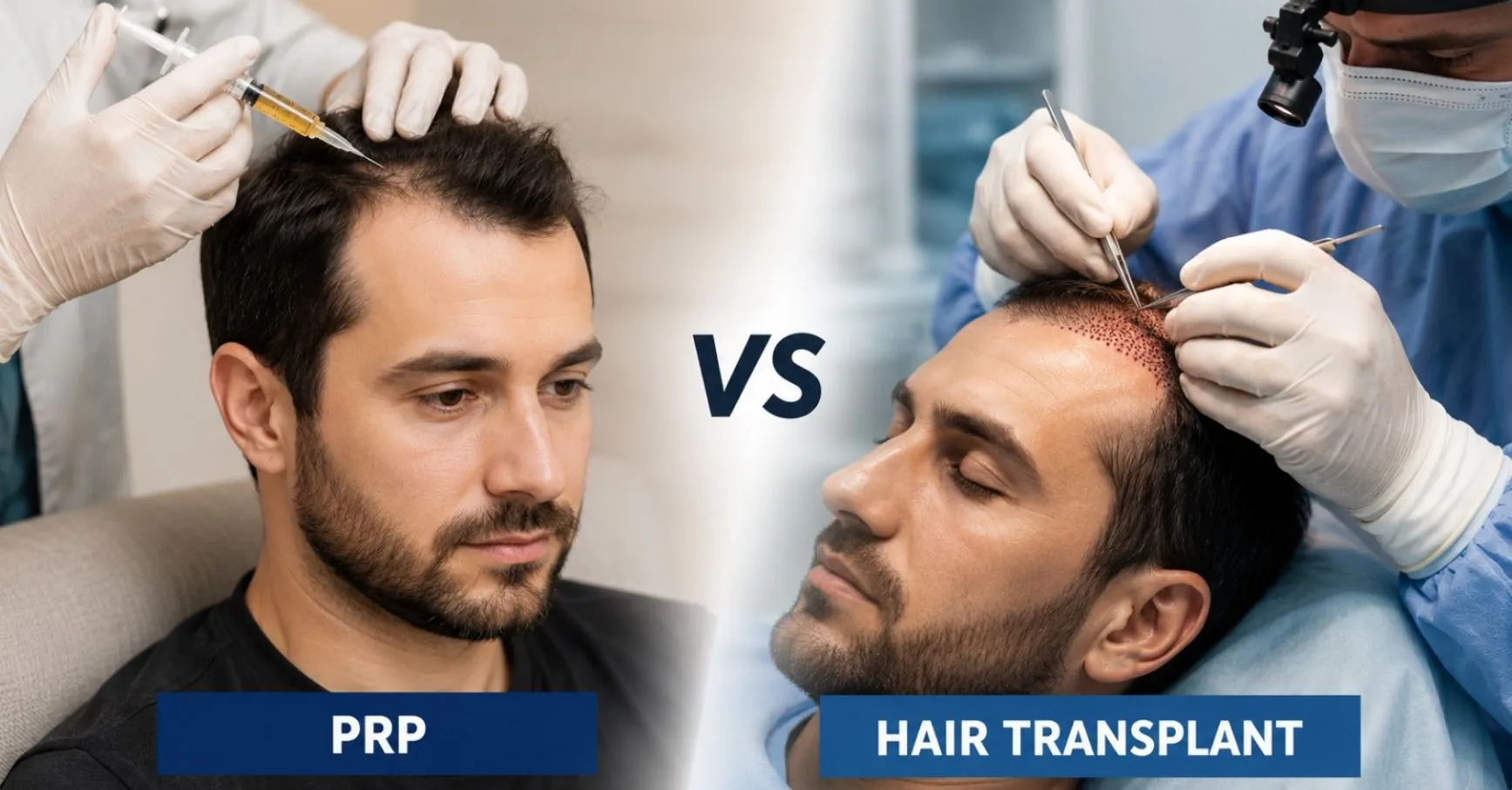
The challenge is that PRP therapy and hair transplants are fundamentally different treatments. One works by biologically stimulating weakened follicles; the other physically replaces lost hair using transplanted grafts. Choosing the wrong path too early can waste time, money, and most importantly your limited donor hair.
At experienced hair restoration clinics in Downtown Dubai and Jumeirah, the decision isn’t about marketing trends. It’s about a clinical understanding of your stage of hair loss, scalp health, donor density, and whether your follicles are still alive.
This flagship guide explains the real differences between PRP hair treatment vs hair transplant, who each is best for, recovery realities, and why many specialists on Sheikh Zayed Road now combine both for superior hair restoration results.
Understanding Hair Loss Before Choosing a Treatment
Hair restoration success depends entirely on a correct diagnosis. Many patients assume every bald patch requires surgery. However, timing is everything in regenerative medicine.
Follicle Miniaturization: The Point of No Return
Hair loss usually follows a process called miniaturization. Due to genetics (Androgenetic Alopecia) or environmental stressors common in Dubai like hard desalinated water and extreme heat follicles begin to shrink. They produce thinner, shorter hairs until they eventually stop producing hair altogether.
- Active Follicles: Thinning hair where the follicle is still alive. These respond well to non-surgical hair treatment like PRP.
- Inactive Follicles: Areas that are completely bald and shiny. Here, the follicle has died. PRP cannot “resurrect” a dead follicle; only a permanent hair restoration via transplant can restore hair here.
Why Timing and Scalp Health Matter
In a city like Dubai, where stress and climate-related shedding are high, your scalp condition dictates your treatment success. If you are experiencing early-stage hair loss, preserving your hair density is the priority. If you have advanced hair loss, the focus shifts to hair restoration through surgical relocation of hair follicles.
What Is PRP Hair Treatment?
Platelet-Rich Plasma (PRP) is a regenerative, non-surgical therapy. It leverages the healing power of your own blood to stimulate hair regrowth.
The Science of Platelet-Rich Plasma
Your blood contains platelets that are rich in growth factors. When concentrated and injected into the scalp, these growth factors (like VEGF and PDGF) encourage neovascularization—the formation of new blood vessels. This improves the blood supply to the hair follicles, extending the growth (anagen) phase and thickening the hair shaft.
The Procedure: From Blood Draw to Scalp Injections
- Extraction: A small amount of blood is drawn, similar to a routine test.
- Centrifugation: The blood is spun in a specialized centrifuge to separate the platelets from the red blood cells.
- Injections: The highly concentrated plasma is delivered via tiny scalp injections into thinning areas like the thinning crown or temples.
Ideal Candidates for PRP in Dubai
PRP is most effective for female hair thinning and men experiencing the early signs of male pattern baldness. It is the “maintenance” gold standard for those who aren’t ready for surgery but want to slow down a receding hairline.
What Is a Hair Transplant?
A hair transplant is a surgical procedure where healthy, DHT-resistant follicles are relocated from a donor area (usually the back of the head) to bald areas.
FUE Hair Transplant (Follicular Unit Extraction)
The most popular method in Dubai is FUE hair transplant. Unlike older methods, FUE involves extracting individual hair follicles one by one. This results in:
- No linear scarring.
- Faster FUE recovery.
- A more natural-looking hairline.
Artistry and Permanence
A successful FUE hair transplant Dubai session isn’t just about moving hair; it’s about the “angulation” and “density” of the grafts. Because the transplanted hair is genetically programmed not to fall out, it provides a permanent hair restoration solution.
PRP vs Hair Transplant: The Core Differences
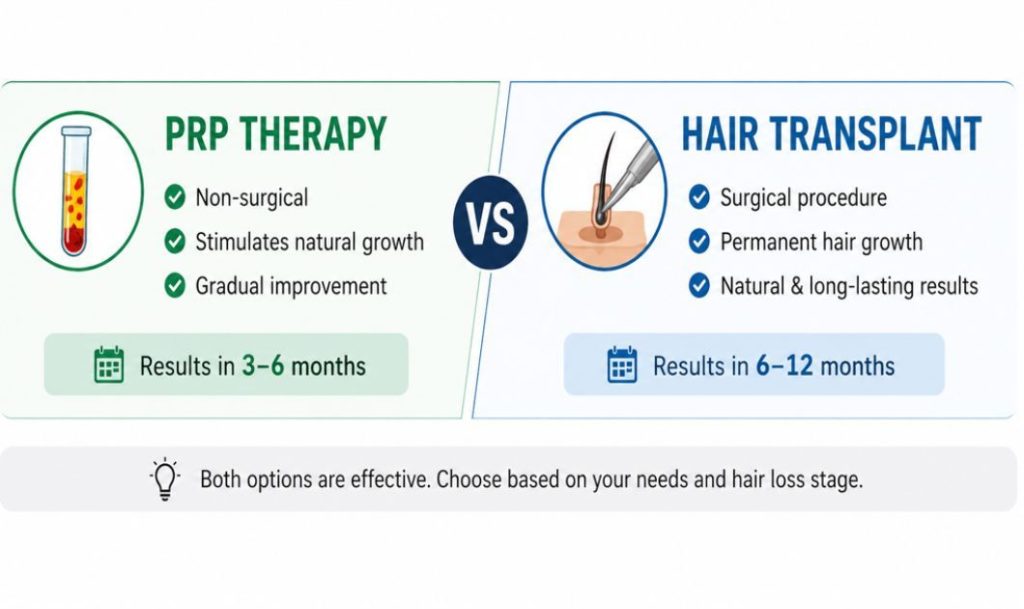
Feature | PRP Hair Treatment | Hair Transplant (FUE/DHI) |
Invasiveness | Non-Surgical | Minimally Invasive Surgery |
Recovery | Zero to 24 hours | 7 to 10 days for visible healing |
Permanence | Requires PRP maintenance sessions | Permanent results |
Best For | Hair thinning & early loss | Bald patches & advanced loss |
Mechanism | Stimulates existing follicles | Relocates new follicles |
Density | Improves existing thickness | Creates density in bald areas |
Downtime | None (Return to work immediately) | 3–5 days recommended |
Which Treatment Works Better for Your Stage of Hair Loss?
1. Early Hair Thinning & Diffuse Loss
If you notice your Parting is wider or your ponytail feels thinner, PRP for hair loss Dubai specialists often recommend starting here. PRP is excellent for “waking up” sleepy follicles and preventing further hair thinning.
2. Receding Hairline & Thinning Crown
Once the hairline has moved back significantly, PRP might thicken the remaining hair, but it won’t bring back the original line. At this stage, a FUE hair transplant is usually necessary to reconstruct the frame of the face.
3. Advanced Baldness
For those with significant advanced hair loss, a transplant is the only viable option. However, the success of the surgery depends on your donor area you must have enough hair at the back of your head to cover the bald areas in front.
Can PRP Replace a Hair Transplant?
We hear this question daily at clinics across Dubai Marina and Al Wasl. The honest answer is: No.
PRP cannot revive a follicle that has completely stopped producing hair. If an area of your scalp is shiny and smooth, there are no follicles left to stimulate. PRP can only improve the “quality” of what is already there. If you want hair where there is currently none, you need a transplant.
Why Dubai Specialists Recommend Combination Therapy
The most sophisticated hair restoration strategies in the UAE don’t choose one over the other. Instead, they use a combination therapy strategy.
PRP + FUE: The Synergy
Many surgeons on Sheikh Zayed Road include a PRP session during or immediately after an FUE hair transplant.
- Graft Survival: PRP growth factors can improve the graft survival rate of the newly implanted follicles.
- Healing: It accelerates the hair transplant recovery process by reducing inflammation.
- Native Hair Protection: While the transplant fixes the bald spots, PRP protects the “native” hair around the transplant from further thinning.
PRP vs Hair Transplant Recovery Timeline
PRP Recovery: The “Lunchtime” Procedure
- Day 1: Slight tenderness or redness at the injection sites.
- Day 2: You can wash your hair and return to full exercise.
- Maintenance: Expect to return every 4–6 weeks for an initial course of 3–4 sessions.
Hair Transplant Recovery: The 12-Month Path
- Days 1–3: Swelling around the forehead and mild discomfort in the donor area.
- Days 7–10: Scabs begin to fall off; the scalp looks mostly healed.
- Weeks 2–4: Shock loss This is normal—the transplanted hairs fall out, but the follicles stay alive under the skin.
- Months 3–4: Early hair regrowth
- Months 6–9: Significant improvement in hair density.
- Month 12: Final results. The hair is now fully matured and can be styled, cut, and treated naturally.
Cost vs. Long-Term Value in Dubai
When evaluating the prp hair treatment vs hair transplant cost, don’t just look at the initial quote.
- PRP Value: Lower upfront cost, but requires ongoing PRP maintenance sessions (usually 1–2 times a year) to keep the results.
- Transplant Value: A higher one-time investment. However, when spread over 10–20 years, it is often more cost-effective as the results are permanent.
In Dubai, beware of “hair mills” offering suspiciously low prices. Quality hair follicles are a finite resource. If a bargain clinic damages your donor area, it cannot be fixed later.
How to Know Which Treatment Is Right for You?
Choosing between PRP or hair transplant requires a professional consultation. Specialists will evaluate:
- Your Age: Younger patients (under 25) are often encouraged to start with PRP and medication to stabilize loss before considering surgery.
- Loss Progression: Is your hair loss stable or rapidly accelerating?
- Expectations: Are you looking for a subtle thickening or a total hairline reconstruction?
- Lifestyle: Can you afford the 7-day social downtime required for a transplant?
Why Patients in Dubai Choose Trusta Clinic
In Trusta Clinic, we don’t believe in a one-size-fits-all approach. Whether you are visiting our Downtown Dubai location or consulting with us from Jumeirah, our medical team prioritizes your long-term aesthetic health.
- Medical Authority: Our procedures are led by experienced surgeons, not just technicians.
- Advanced Technology: We utilize the latest FUE and DHI tools for maximum graft survival.
- Personalized Care: We combine regenerative hair therapy with surgical precision to ensure your results look natural from every angle.
Frequently Asked Questions
Is PRP better than a hair transplant?
Neither is “better.” PRP is superior for early thinning and maintenance, while a hair transplant is the only way to restore hair in truly bald areas.
Can PRP regrow hair on bald areas?
No. PRP can only thicken existing hair follicles that are still active. It cannot create new hair on a smooth, bald scalp.
Is FUE permanent?
Yes. Follicles taken from the back of the head are genetically resistant to DHT (the hormone that causes hair loss), meaning they will continue to grow for a lifetime.
How many PRP sessions are needed?
Most patients require an initial course of 3–4 sessions, spaced one month apart, followed by maintenance every 6 months.
Does PRP hurt?
We use specialized cooling techniques and tiny needles. Most patients describe it as a minor pinching sensation—far less intense than most people imagine.
What age is best for a hair transplant?
Most surgeons recommend waiting until at least age 25 to ensure your hair loss pattern has stabilized.
Conclusion
The path to hair restoration in Dubai is personal. If you are in the early stages of thinning, PRP hair treatment offers a powerful, non-surgical way to protect your density. If you have moved into advanced loss, an FUE hair transplant provides the permanent, natural-looking reconstruction you need.
The most important step is not choosing a treatment—it’s choosing a diagnosis. By consulting with a specialist who understands the nuances of the Dubai climate and the biology of hair growth, you ensure that your investment leads to the reflection you want to see in the mirror.
Ready to determine the best path for your hair?
Contact Trusta Clinic today for a personalized scalp and donor assessment.