
June 9, 2026
Combining Microneedling with Chemical Peels: Benefits, Results, and Professional Insights
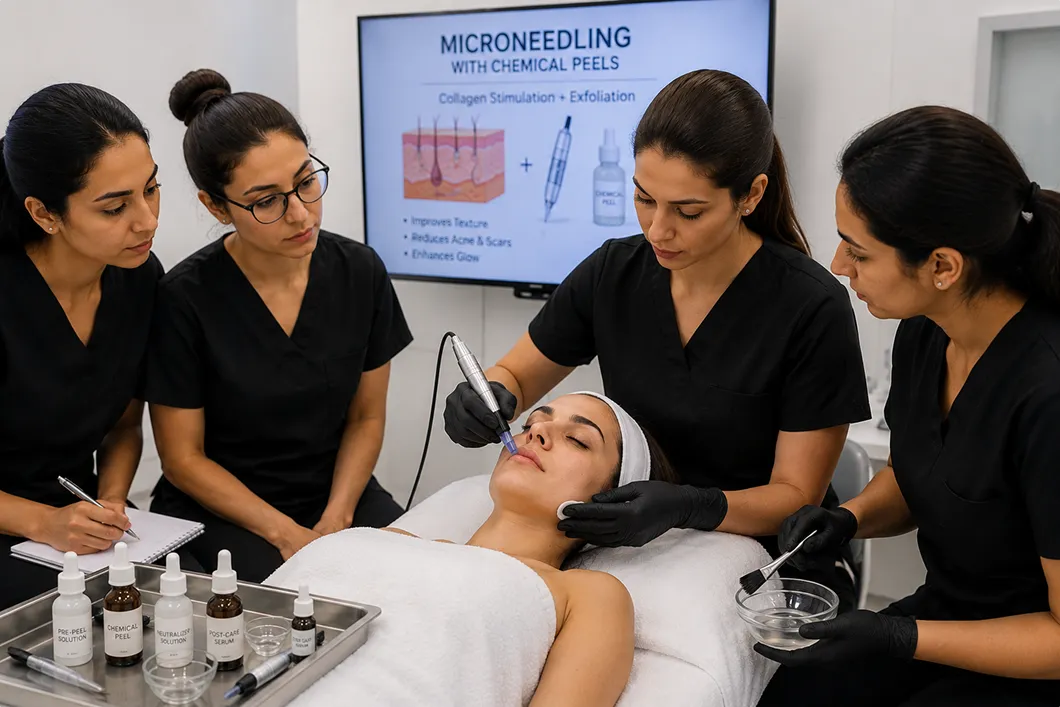
Combining microneedling with chemical peels is one of the most effective approaches in modern aesthetic practice. As patients become more informed, their expectations for results continue to rise. In response, practitioners across Dubai and internationally are turning to combination protocols that address multiple skin concerns within a single treatment programme.
Acne scars, hyperpigmentation, fine lines, enlarged pores, and uneven texture rarely respond fully to one treatment alone. Microneedling stimulates the skin’s own collagen production through controlled micro-injury. Chemical peels, on the other hand, accelerate cellular turnover and resurface the outer skin layers. Together, therefore, they create a synergistic effect that delivers more comprehensive skin renewal than either treatment achieves independently.
Both procedures are well-established in clinical practice and supported by strong evidence. However, combining them requires careful patient assessment, correct treatment sequencing, and the practitioner skill to adapt protocols to individual skin type and concern.
Whether you are a patient exploring your options or a practitioner building advanced clinical skills, this guide covers everything you need to know how each treatment works, when to combine them, what results to expect, and why proper training makes all the difference.
Book a Consultation at Trusta Clinic Dubai →
What Happens When You Combine Microneedling with Chemical Peels?
Combining microneedling with chemical peels enhances skin renewal by triggering two complementary mechanisms at once. Microneedling creates micro-channels that stimulate collagen production and improve active ingredient absorption. Chemical peels, meanwhile, remove damaged surface cells and accelerate cellular turnover. Together, they deliver deeper rejuvenation, improved texture, and a more even skin tone than either treatment achieves on its own.
When both treatments are applied within a structured protocol, the skin undergoes a more comprehensive renewal process. The micro-channels created by microneedling allow chemical peel actives to penetrate the dermis more effectively, maximising their impact on pigmentation, scar tissue, and cellular irregularity. At the same time, the peel’s exfoliating action prepares the skin surface to respond more readily to the collagen induction triggered by the needling.
As a result, this combined approach addresses the full depth of skin concern from surface texture and tone through to deeper structural remodelling within a cohesive, clinically managed programme.
Microneedling vs Chemical Peel: Which Is Better?
Neither treatment is universally superior. The better choice depends entirely on the patient’s skin concern, skin type, tolerance for downtime, and treatment goals. For many patients, however, the most effective approach is not choosing between the two it is using both strategically.
| Concern | Microneedling | Chemical Peel |
|---|---|---|
| Acne Scars | Excellent — remodels scar tissue through collagen induction | Good — improves surface texture and post-inflammatory pigmentation |
| Hyperpigmentation | Moderate — helps deeper pigmentation over a series | Excellent — targets melanin overproduction at the epidermal level |
| Wrinkles | Excellent — stimulates new collagen and elastin fibres | Good for fine lines; limited effect on deeper expression lines |
| Skin Texture | Excellent — smooths irregularity and refines pores | Excellent — removes dead skin cells and resurfaces outer layers |
| Enlarged Pores | Good — tightens pore walls through dermal remodelling | Good — clears debris and reduces the appearance of blocked pores |
| Recovery Time | 24–72 hours of redness and mild swelling | 2–7 days depending on depth; possible peeling and sensitivity |
| Results Timeline | Progressive over 4–6 weeks; course of 3–6 sessions recommended | Visible within 1–2 weeks; cumulative improvement with a series |
For patients with complex concerns scarring combined with pigmentation, or texture irregularity alongside fine lines a combined protocol addresses both layers of the problem simultaneously.
Chemical Peel or Microneedling First?
In most combination protocols, chemical peels are performed before microneedling. The peel resurfaces and prepares the skin by removing the dead cell layer and optimising the surface for the needling treatment that follows. However, the correct sequence depends on peel depth, the microneedling device used, and the individual patient’s skin assessment. Always consult a qualified practitioner before combining treatments.
Sequencing is one of the most important clinical considerations in combination skin treatment. As a general principle, a light-to-medium chemical peel applied before microneedling prepares the skin surface, enhances penetration of actives during the needling phase, and produces a more uniform result. Conversely, performing a peel after microneedling on already-stimulated skin risks over-treatment and adverse reaction.
Some advanced protocols involve separate sessions within a structured programme for example, alternating microneedling and chemical peel sessions spaced two to four weeks apart. This approach allows each treatment to deliver its full effect without compounding skin stress in a single sitting.
Ultimately, the right answer for any individual patient comes from a thorough consultation. Skin type, sensitivity, current skin health, medications, and treatment history all influence the correct sequence and protocol.

Microneedling vs Chemical Peel for Hyperpigmentation
Hyperpigmentation is caused by an overproduction of melanin, triggered by sun exposure, hormonal changes, post-inflammatory response (commonly from acne), or skin trauma. It appears as uneven skin tone, dark spots, melasma, and discolouration concerns that patients consistently rank among the most distressing.
Chemical peels particularly those containing glycolic acid, lactic acid, kojic acid, or TCA are highly effective for surface-level hyperpigmentation. They disrupt melanin-producing cells in the epidermis and accelerate the shedding of pigmented cells, producing visible lightening within days of the peel completing.
Microneedling, by contrast, addresses hyperpigmentation differently. By stimulating collagen production and improving cellular turnover at the dermal level, it is particularly effective for post-inflammatory hyperpigmentation (PIH) that sits deeper than the surface layers. Furthermore, when combined with vitamin C, tranexamic acid, or niacinamide serums infused during treatment, microneedling becomes a highly targeted approach for stubborn pigmentation.
For melasma one of the most treatment-resistant forms of hyperpigmentation a combined approach using superficial peels and microneedling with appropriate actives has shown strong clinical outcomes. This is especially true in darker skin tones, where the risk of post-treatment PIH must be carefully managed.
The combination of microneedling with chemical peels therefore delivers results at both the epidermal and dermal level, addressing existing pigmentation and the cellular behaviour that caused it.
Microneedling vs Chemical Peel for Wrinkles
Fine lines and deeper expression lines develop as collagen and elastin production slows with age. Repetitive muscle movement also creates permanent creases in skin that has lost its structural resilience.
Microneedling addresses wrinkles at the root cause. By creating controlled micro-injury, it triggers the skin’s natural wound healing response and stimulates fibroblast activity the cells responsible for producing new collagen and elastin fibres. Over a course of sessions, consequently, the dermis becomes structurally denser, fine lines soften, and skin firmness improves progressively. The periorbital area, forehead, perioral zone, and neck all respond well to a consistent microneedling programme.
For patients with more significant skin laxity or deeper lines, RF microneedling and Secret RF microneedling extend results beyond what standard needling achieves. Radiofrequency energy is delivered precisely into the dermis via insulated needles, triggering additional tissue contraction and remodelling. Secret RF Microneedling, in particular, is widely regarded as one of the most effective non-surgical approaches to skin laxity available in clinical aesthetic practice today.
Chemical peels contribute to wrinkle improvement by removing the dull, damaged outer cell layers that make fine lines more visible. They also promote epidermal cell regeneration. Superficial and medium peels are effective for fine lines around the eyes and mouth. However, their impact on deeper structural laxity is limited compared to microneedling and RF-based protocols.
Combining both treatments produces the most comprehensive anti-aging outcome: surface renewal from the peel, and deep structural regeneration from the microneedling.
Microneedling vs Chemical Peel for Acne
The relationship between acne and aesthetic treatment requires careful clinical distinction. Active acne and acne scarring are separate concerns, and the treatment approach differs significantly between them.
For active acne: Chemical peels – particularly salicylic acid peels are highly effective during active breakout phases. Salicylic acid is lipophilic, meaning it penetrates sebaceous follicles and dissolves the sebum, dead cells, and bacteria that cause congestion and inflammation. Regular superficial peels reduce the frequency and severity of active breakouts and are well-tolerated across most skin types.
Microneedling is generally not recommended during active acne phases, since needling inflamed skin risks spreading bacteria and worsening the breakout. Treatment with microneedling is therefore typically scheduled once the active phase is managed.
For acne scarring: Microneedling is among the most effective treatments available for ice pick, rolling, and boxcar scars. It remodels scar tissue from within, progressively softening and flattening scarring over a series of sessions. Dermapen microneedling is particularly well-suited to scar revision due to its precision depth control and ability to treat small, contoured areas accurately.
Chemical peels complement scar treatment by addressing the post-inflammatory hyperpigmentation (PIH) that frequently accompanies scarring. In this way, they improve the surface colour irregularity that makes scarring more visible.
For patients with both scarring and residual PIH one of the most common presentations in aesthetic practice microneedling with chemical peels provides the most complete treatment pathway.
Benefits of Combining Microneedling with Chemical Peels
The clinical case for combining both treatments is strong. When sequenced and delivered correctly, the combination produces outcomes that neither treatment achieves independently:
- Enhanced collagen and elastin production – microneedling stimulates fibroblast activity while the peel removes the surface barrier that limits regenerative efficiency
- Deeper active ingredient penetration – micro-channels created during needling allow chemical peel actives and serums to reach the dermis directly
- Improved skin texture – surface resurfacing from the peel combined with dermal remodelling from microneedling produces smoother, more uniform skin
- More even skin tone – the peel addresses epidermal pigmentation while microneedling works on deeper post-inflammatory discolouration
- Reduced acne scarring – structural scar remodelling combined with pigmentation correction delivers comprehensive scar improvement
- Reduced fine lines and surface wrinkles – surface renewal and collagen stimulation work at different depths for more complete anti-aging results
- Refined pore appearance – pore wall tightening from needling combined with debris removal from the peel produces lasting refinement
- More comprehensive skin rejuvenation – addressing both the epidermal and dermal level within a structured programme delivers results that a single-modality approach cannot match
Advanced Combination Treatments
For patients with more complex concerns or practitioners seeking to deliver premium outcomes advanced combination protocols extend results further.
Microneedling with PRP
Platelet-rich plasma combined with microneedling creates a powerful regenerative synergy. PRP is derived from the patient’s own blood through centrifugation and contains a concentrated dose of growth factors. These factors accelerate collagen production, tissue repair, and skin regeneration. Applied topically during microneedling or delivered via micro-infusion through the channels created by the device, PRP enhances the healing response and produces noticeably superior skin quality outcomes. Microneedling with PRP is particularly effective for acne scarring, hair loss treatment, and accelerated skin rejuvenation in patients with depleted collagen reserves.
RF Microneedling
Radiofrequency microneedling combines the collagen induction effect of standard needling with the tissue remodelling power of radiofrequency energy. RF energy is delivered through the microneedle tips precisely into the dermis, triggering thermal contraction and deep tissue remodelling that standard microneedling cannot achieve. As a result, outcomes are measurably superior for skin laxity, deeper scarring, and textural irregularity particularly in patients who have not achieved their goals through standard microneedling alone.
Secret RF Microneedling
Secret RF is one of the most clinically advanced RF microneedling systems available in professional aesthetic practice. Its insulated needle technology ensures RF energy is deposited precisely in the target dermis layer without surface trauma. Consequently, it enables effective treatment across all skin types, including darker Fitzpatrick types where surface thermal injury is a clinical concern. Secret RF Microneedling delivers exceptional outcomes for skin tightening, scar revision, and comprehensive rejuvenation, and is a flagship treatment at Trusta Medical Center.
Dermapen Microneedling
Dermapen is the most widely used professional microneedling device in clinical aesthetics globally. Its precision depth control, adjustable needle speed, and contoured tip design make it the clinical standard for facial microneedling treatments. Dermapen microneedling is highly effective both as a standalone treatment and as a delivery mechanism for serums and active ingredients when combined with chemical peel protocols. Practitioners trained on Dermapen can therefore deliver consistently accurate results across different skin types, treatment areas, and clinical concerns.
Microneedling Before and After – What Results Can You Expect?
After a series of microneedling treatments, patients typically see progressive improvement in skin texture, scarring, pigmentation, and firmness over four to six weeks per session. Most concerns require three to six sessions for optimal results. Combining microneedling with chemical peels accelerates visible improvement and addresses a broader range of concerns within the same treatment timeline.
Results from microneedling develop progressively rather than immediately, because the mechanism is collagen stimulation — a biological process that takes weeks to fully manifest. Understanding this timeline is important for both practitioners and patients.
After the first session: Skin appears brighter and more even within one to two weeks. Minor improvements in texture are often visible, along with a general enhancement in skin quality and radiance.
After three sessions: Meaningful improvement in acne scarring, enlarged pores, and fine lines becomes visible. Skin tone becomes more uniform and overall firmness improves noticeably.
After a full course of six sessions: Significant structural improvement in scarring becomes apparent, alongside measurable reduction in fine lines and laxity. Sustained improvement in skin tone and texture is also typical. Importantly, results continue to develop for up to three months after the final session as collagen matures.
Maintenance: Most patients maintain results with one to two sessions per year after completing their initial course.
When chemical peels are incorporated into the programme, surface improvements particularly in pigmentation and overall radiance are visible earlier and more dramatically than with microneedling alone.
Professional Perspective: Why Proper Training Matters
The quality of outcomes from microneedling with chemical peels depends almost entirely on the skill of the practitioner delivering the treatment.
Needle depth selection, device handling technique, peel strength selection, treatment sequencing, and patient assessment are all clinical decisions that require proper education and supervised practice. A treatment delivered with the wrong depth setting, the wrong peel concentration, or on skin that was inadequately assessed can produce adverse outcomes post-inflammatory hyperpigmentation, prolonged erythema, barrier disruption, or scarring that are entirely avoidable with proper training.
In Trusta Academy, our Microneedling Training Course equips practitioners with the clinical foundations, hands-on skills, and advanced technique knowledge to deliver microneedling treatments safely and confidently from their first independent session. Training takes place inside Trusta Medical Center a fully operational licensed clinical facility in Downtown Dubai, not a purpose-built training suite separated from real clinical practice.
Our Chemical Peel Course in Dubai covers peel chemistry, depth classification, skin type assessment, protocol selection, and safety management for the full range of professional chemical peels. Participants learn to combine peel protocols with other aesthetic treatments within a clinically reasoned framework.
For practitioners ready to build comprehensive skin rejuvenation skills, our professional aesthetic courses in Dubai cover the full range of advanced techniques from RF microneedling and PRP integration to laser treatments and combination protocols delivered by active clinical professionals inside a real medical aesthetic environment.
Proper training is not just about safety. It is about delivering the results patients trust you to achieve.
Combined Treatment Benefits at a Glance
| Skin Concern | Microneedling | Chemical Peel | Combined Approach |
|---|---|---|---|
| Acne Scars | Remodels scar tissue through collagen induction | Improves surface texture and residual PIH | Structural remodelling + surface correction = comprehensive scar improvement |
| Hyperpigmentation | Targets deep PIH; improves with active infusion | Disrupts epidermal melanin; visible lightening within days | Epidermal and dermal pigmentation addressed simultaneously |
| Fine Lines | Stimulates new collagen and elastin fibres | Resurfaces outer skin layers; improves surface lines | Surface renewal + structural regeneration = most complete anti-aging result |
| Texture Issues | Refines pore walls and dermal structure | Removes dead cell layer; smooth surface renewal | Multi-depth resurfacing for superior texture improvement |
| Enlarged Pores | Tightens pore walls through dermal remodelling | Removes sebum and debris; reduces congestion | Structural tightening + thorough cleansing = lasting pore refinement |
Who Is a Good Candidate for Combined Treatment?
Combined microneedling with chemical peels is well-suited to a broad range of patients. However, the most appropriate candidates share one common characteristic: their skin concern exists at more than one level of the skin.
Acne scar patients benefit most from combination treatment. The scarring itself requires dermal remodelling, while the residual pigmentation and uneven texture that typically accompany it respond better to chemical peel resurfacing.
Patients with hyperpigmentation who have not achieved full correction with peels alone often see significantly improved results when microneedling is incorporated into the programme. This is particularly true for deeper post-inflammatory pigmentation.
Patients with aging skin concerns fine lines, surface laxity, and declining skin quality benefit from the collagen stimulation of microneedling and the cellular renewal of chemical peels working together progressively.
Patients with uneven texture and enlarged pores achieve more comprehensive results through the dual mechanism of surface resurfacing and dermal tightening than through either treatment alone.
Who should not combine treatments: Patients with active skin infections, open lesions, active acne, known sensitivity to peel agents, blood-thinning medications, pregnancy, or keloid-prone skin require careful assessment before any combination protocol is considered. In all cases, a thorough consultation with a qualified practitioner is non-negotiable.
Conclusion
The evidence for combining microneedling with chemical peels is clear. When sequenced and delivered correctly by a qualified practitioner, the combination addresses skin concerns at multiple levels simultaneously — producing results in texture, pigmentation, scarring, and skin quality that neither treatment achieves independently.
Whether you are managing acne scarring, persistent hyperpigmentation, early skin aging, or general skin quality concerns, a professionally structured combination programme delivers more comprehensive improvement within a realistic treatment timeline.
For patients in Dubai, Trusta Clinic offers expert-led consultations to assess your skin, identify the right combination protocol for your specific concerns, and deliver treatment within our fully licensed clinical facility in Downtown Dubai.
For practitioners, Trusta Academy provides hands-on professional training in microneedling, chemical peels, RF microneedling, and advanced combination protocols delivered inside a real clinical environment by qualified medical professionals who treat patients every day.
Book your consultation at Trusta Clinic, or explore professional training at Trusta Academy today.
Book a Skin Consultation → | Explore Aesthetic Training Courses →
Frequently Asked Questions
What is better, chemical peel or microneedling?
Neither treatment is universally better the right choice depends on your skin concern. Chemical peels are more effective for surface-level hyperpigmentation and early fine lines. Microneedling, however, delivers superior results for acne scarring and skin laxity. For patients with multiple concerns, combining both produces more comprehensive results than choosing one treatment alone.
Do chemical peels really reduce fine lines and wrinkles?
Yes, chemical peels reduce fine lines by removing damaged surface skin cells and stimulating epidermal renewal. Medium and deep peels produce the most visible improvement in perioral and periorbital fine lines. However, for deeper structural laxity and expression lines, microneedling or RF microneedling delivers stronger collagen remodelling results. Combining both treatments therefore addresses surface and structural ageing simultaneously.
Can acne scars be treated by chemical peeling?
Yes, chemical peels improve acne scars by resurfacing the skin surface and reducing post-inflammatory hyperpigmentation. However, they are most effective for the pigmentation aspect of scarring rather than structural depth. For ice pick, rolling, and boxcar scars, microneedling produces superior structural remodelling. Consequently, the most effective approach combines microneedling with chemical peels across a structured treatment programme.
Chemical peel or microneedling first?
In most combination protocols, the chemical peel is performed before microneedling. The peel resurfaces and prepares the skin, enhancing the penetration and effectiveness of the needling treatment that follows. However, the correct sequence depends on peel depth, the device used, and your individual skin assessment. Some protocols use separate sessions spaced weeks apart. Always follow the guidance of your treating practitioner.
Microneedling vs chemical peel for hyperpigmentation – which works better?
Both treatments address hyperpigmentation through different mechanisms. Chemical peels work at the epidermal level, disrupting melanin-producing cells and accelerating the shedding of pigmented surface skin. Microneedling, on the other hand, targets deeper post-inflammatory pigmentation and improves results when combined with brightening actives. For comprehensive pigmentation correction particularly for melasma or deep PIH combining both produces the most complete outcome.
Is RF microneedling better than traditional microneedling?
RF microneedling delivers stronger results for skin laxity, deeper scarring, and textural improvement than traditional microneedling alone. Radiofrequency energy delivered through the needle tips triggers deep tissue remodelling and contraction that standard needling cannot achieve. Secret RF Microneedling is particularly effective across all skin types. Traditional microneedling, however, remains excellent for skin quality, fine lines, and surface concerns. The right choice ultimately depends on the severity of the concern and the patient’s goals.
Can microneedling and chemical peels be combined safely?
Yes, microneedling with chemical peels can be combined safely when performed by a qualified practitioner who understands correct treatment sequencing, protocol selection, and patient assessment. The combination is contraindicated in active acne, active skin infections, pregnancy, and certain medication regimens. A thorough pre-treatment consultation is therefore essential. When delivered correctly in a professional clinical environment, the combination is both safe and highly effective.