
July 3, 2026
Choosing between fat transfer breast augmentation vs implants is one of the most significant decisions you’ll make on your aesthetic journey. For women in Dubai seeking natural-looking results, this choice carries even greater weight. The contrast between using your own body’s resources versus introducing synthetic materials has never been more relevant, with more women questioning which path offers the ideal balance of safety, beauty, and longevity.
Dubai has firmly established itself as a global hub for advanced cosmetic procedures, with world-class plastic surgeons offering both techniques at the highest standards. The city’s reputation for luxury and excellence naturally extends to its aesthetic clinics, making it a sought-after destination for breast enhancement. You deserve to understand both options inside out before making this personal decision.
What Is Fat Transfer Breast Augmentation?
Fat transfer breast augmentation, also called autologous fat transfer breast surgery or natural breast augmentation, uses liposuction to remove fat from areas such as the abdomen, flanks, or thighs. The harvested fat is then purified and carefully re-injected into the breasts, layer by layer, to add volume and improve shape. This technique has become a popular choice for women seeking breast augmentation Dubai options that deliver subtle, natural-looking enhancement without implants.
Because the added tissue is your own, the result tends to look and feel remarkably natural. There’s no foreign material involved, which is exactly why many women exploring breast augmentation Dubai or looking for breast augmentation without implants in Dubai choose this procedure first.
That said, fat transfer isn’t the right solution for everyone. It typically increases breast size by up to one cup size and works best for women who have enough donor fat available for harvesting while seeking a modest, natural enhancement.
How Do Breast Implants Work?
Breast implants involve placing a silicone or saline device into a pocket created either above or below the chest muscle. Surgeons can adjust size, shape, projection, and placement to achieve a highly customised, dramatic result.
Implants remain the gold standard when a woman wants a significant size increase think one, two, or even three cup sizes with predictable, long-lasting outcomes. Decades of clinical data back their safety profile, and both saline and silicone devices carry regulatory approval in most major markets, including the UAE.
Fat Transfer Breast Augmentation vs Implants: The Core Differences
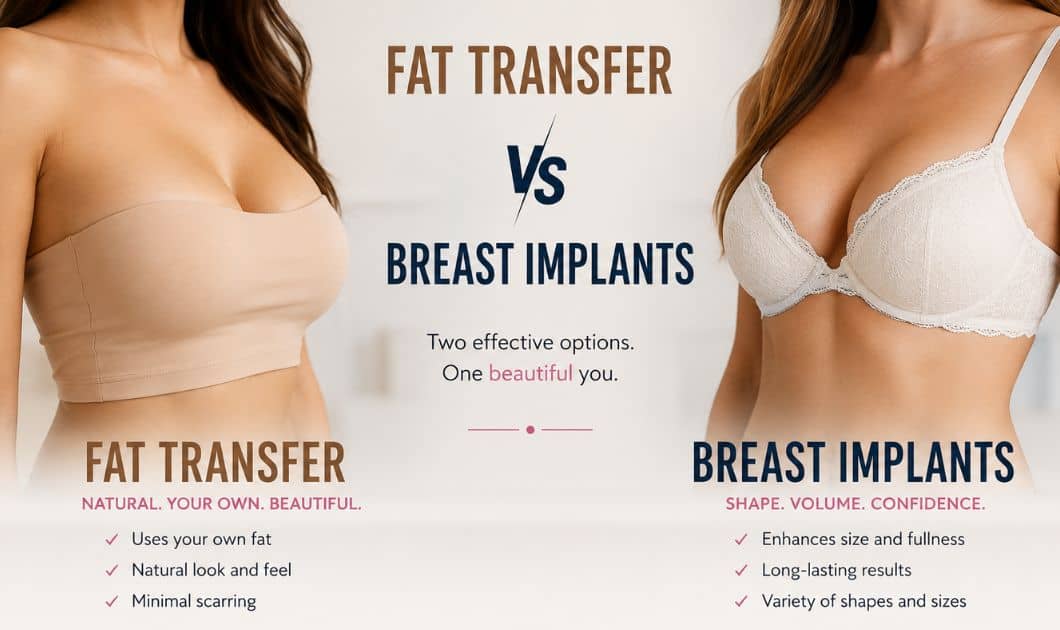
Before diving deeper, here’s a side-by-side snapshot to anchor the rest of this comparison.
| Factor | Fat Transfer | Breast Implants |
|---|---|---|
| Size increase | Subtle, up to ~1 cup size | Significant, 1–3+ cup sizes |
| Material | Your own body fat | Silicone or saline |
| Feel | Very natural | Natural to firm, depending on type |
| Scarring | Minimal (small liposuction sites) | Small incision scars |
| Longevity | Long-lasting once fat “takes” | 10–15 years typically |
| Recovery | Faster, 1–2 weeks | 2–4 weeks |
| Added benefit | Body contouring at donor site | None |
| Best for | Modest, natural enhancement | Dramatic, defined enhancement |
Neither column is objectively “better.” Instead, each row should map onto what actually matters to you.
What Are the Benefits of Fat Grafting Breast Enhancement?
Choosing fat grafting breast enhancement comes with several genuine advantages that go beyond simply avoiding implants.
It Feels and Moves Naturally
Since the tissue is biologically yours, augmented breasts move, feel, and settle the way natural breast tissue does. Many women say this is the single biggest reason they chose fat transfer over implants.
You Get a Bonus Body Contouring Effect
Liposuction doesn’t just harvest fat it also slims and reshapes the donor area, whether that’s your waist, thighs, or lower back. You essentially get two treatments in one session.
There’s Virtually No Risk of Rejection
Because your immune system recognises your own fat, there’s no risk of the tissue being rejected the way a foreign implant occasionally can be.
Scarring Is Minimal
Liposuction cannulas leave tiny puncture marks rather than long incisions, so visible scarring is far less of a concern than with implant surgery.
What Are the Disadvantages of Fat Transfer?
To keep this comparison balanced, it’s worth being upfront about the downsides too, since this is one of the most common questions patients ask before booking a consultation.
- Fat resorption: Not all transferred fat cells survive. Depending on technique and aftercare, anywhere from 20% to 50% of the injected volume may be reabsorbed by the body over the following months.
- Limited volume increase: If you’re hoping for a dramatic size jump, fat transfer alone usually won’t get you there.
- Fat necrosis and calcification: Occasionally, transferred fat cells die off and form small calcified lumps. These are usually harmless but can occasionally complicate future mammogram readings.
- Requires sufficient donor fat: Very lean patients may not have enough fat available to harvest for a meaningful result.
- Less predictable outcome: Because final volume depends on how well the fat “takes,” results can vary more than they do with a sized, solid implant.
Understanding these trade-offs upfront helps set realistic expectations, which is a huge part of walking away satisfied with your results.

How Long Does Fat Transfer Last in Breasts?
Once transferred fat cells establish a blood supply, usually within a few months of surgery, they behave like permanent breast tissue and can last indefinitely. The catch is that this only applies to the fat that survives the initial healing period.
Most surgeons advise patients to wait three to six months before judging the final result, since some early swelling will subside and some fat will naturally reabsorb during that window. Weight fluctuations after surgery can also affect long-term volume, since the transferred fat behaves like any other fat cell in your body.
The Advantages of Breast Implants
Implants earn their reputation as the most requested breast enhancement procedure worldwide for good reason.
Predictable, Dramatic Results
Surgeons can select exact implant volume, profile, and shape, giving you far more control over the final outcome than fat transfer allows.
Decades of Safety Data
Silicone and saline implants have been studied extensively for over 50 years, giving both surgeons and patients a well-documented safety and performance history.
Long-Term Durability
Modern cohesive silicone implants typically last 10 to 15 years before replacement is even a consideration, and many patients go well beyond that without issue.
What Are the Risks of Breast Implants?
Implants aren’t without their own considerations, and an honest comparison has to include them.
- Capsular contracture: Scar tissue around the implant can tighten and harden, sometimes requiring corrective surgery.
- Rupture or deflation: Implants carry an estimated rupture risk of roughly 1% per year, meaning the longer you have them, the higher the cumulative chance of needing a replacement.
- Rippling: Visible or palpable wrinkling can occur, particularly in very slim patients with limited natural tissue coverage.
- Changes in nipple sensation: Surgical incisions can temporarily or, less commonly, permanently affect sensitivity.
- Eventual replacement: While implants don’t need routine removal at a fixed interval, most patients will require a revision procedure at some point in their lifetime.
Natural Breast Augmentation in Dubai: Who Is the Ideal Candidate?
Dubai’s cosmetic surgery scene has grown fast, and demand for natural breast augmentation in Dubai has climbed right alongside it largely driven by patients who want enhancement without the maintenance commitment implants require.
Fat transfer tends to suit you best if:
- You want a subtle, natural-looking lift of half to one cup size
- You have enough donor fat in areas like your abdomen or thighs
- You’re drawn to the idea of a dual benefit — body contouring plus breast enhancement
- You prefer to avoid foreign material in your body altogether
- You’ve experienced mild volume loss after pregnancy, breastfeeding, or weight loss
Implants may be the smarter choice if:
- You want a significant size increase of one or more cup sizes
- You have very little natural fat available to harvest
- You want maximum control over final shape and projection
- You’re comfortable with the idea of a future replacement procedure
Cost Comparison: Fat Transfer vs Implants in Dubai
Pricing varies by clinic, surgeon experience, technique, and how much correction is required, but as a general guide:
- Fat transfer breast augmentation tends to cost more per unit of volume gained, since it combines liposuction and grafting in one procedure, but often works out comparable to implants once you factor in the added body contouring benefit.
- Breast implants typically involve a single, more standardised fee covering the implant device, surgical time, and aftercare.
The only reliable way to get an accurate figure for your specific goals is an in-person consultation, since donor site availability, desired size, and implant type all affect the final quote.
Recovery Timeline: What to Expect From Each Procedure
Recovery experiences differ meaningfully between the two approaches.
Fat transfer recovery generally involves one to two weeks of downtime, with mild soreness at both the donor site and the breasts. Compression garments are usually worn at the liposuction sites for several weeks to support optimal fat survival.
Implant recovery tends to run slightly longer, often two to four weeks before returning to normal activity, with strenuous exercise avoided for around six weeks. Swelling and tightness across the chest are common in the first few weeks as the tissue adjusts to the new implant.
How to Decide: A Quick Self-Check
Ask yourself these three questions before your consultation:
- Am I looking for a subtle enhancement, or a dramatic one? Subtle points toward fat transfer; dramatic points toward implants.
- Do I have enough donor fat available? If you’re very lean, implants may simply be the more realistic option.
- How do I feel about long-term maintenance? Implants generally involve planning for an eventual replacement; fat transfer, once it settles, doesn’t carry that same built-in timeline.
There’s no wrong answer here just an honest one, based on your body and your priorities.
Why Consultation Matters More Than the Procedure Name
No blog post, however detailed, can replace a hands-on assessment. An experienced surgeon will examine your breast tissue, skin elasticity, and available donor fat, then walk you through which approach or combination of both will get you closest to your goals with the least risk.
If you’re exploring your options, it’s worth booking a breast augmentation consultation in Dubai to get a personalised assessment rather than relying on generic size charts. Many clinics, including ours, also offer combined approaches using implants for structural volume and a light layer of fat grafting for softer, more natural contouring at the edges.
Frequently Asked Questions
Are implants or fat transfer better for breasts?
Neither is universally “better” they serve different goals. Implants suit patients wanting a significant, predictable size increase, while fat transfer suits those wanting a subtle, natural-feeling enhancement with no foreign material. The right choice depends on your desired size, available donor fat, and comfort with long-term maintenance.
What are the disadvantages of fat transfer?
The main drawbacks include partial fat resorption (meaning some injected volume is naturally reabsorbed by the body), a limited overall size increase, the small possibility of fat necrosis or calcified lumps, and a less predictable final outcome compared to a sized implant. Patients also need sufficient donor fat available for harvesting.
How long does fat transfer last in breasts?
Fat that successfully establishes a blood supply, usually within three to six months of surgery, tends to last indefinitely and behaves like normal breast tissue from that point forward. However, a portion of the initially transferred fat is reabsorbed during the healing process, so the final surviving volume is what determines the long-term result.
Why are celebrities removing their breast implants?
Public figures cite a range of personal reasons for implant removal, including changing aesthetic preferences over time, discomfort or capsular contracture, a desire to return to a more natural look, or simply wanting a fresh start after years with implants. These are individual medical decisions, and specifics vary case by case rather than following one universal trend.
What is the most regretted cosmetic surgery?
Surveys and patient satisfaction studies vary, but procedures with higher reported regret often share common threads: unrealistic expectations going in, insufficient research into the surgeon’s experience, or choosing a size or style that didn’t match the patient’s actual lifestyle and body frame. Breast augmentation itself has high satisfaction rates overall; regret is far more closely tied to preparation and surgeon selection than to the procedure type.
Which actresses have had breast implants?
Many public figures have spoken openly about cosmetic procedures over the years, though the specifics of any individual’s surgical history are personal and not something we can verify or comment on here. If you’re researching real-world results, before-and-after galleries from board-certified surgeons offer a far more reliable reference point than celebrity speculation.
What is a ballerina breast implant?
A “ballerina” breast augmentation refers to a technique where the implant is placed higher and closer together, creating a lifted, athletic silhouette often associated with dancers and performers. It’s a placement style rather than a distinct implant type, and it’s typically discussed as a specific request during your surgical consultation.
How can you tell if someone has breast implants?
Common visual and physical indicators include a rounder upper breast contour, more symmetrical shape and positioning than typical natural breast tissue, minimal movement or “bounce,” and visible scarring near the underarm, areola, or breast fold. That said, technique and skill vary widely, and a well-placed implant with a skilled surgeon can look and feel virtually indistinguishable from natural tissue.