
July 16, 2026
Mini Facelift vs Full Facelift is a common consideration for anyone noticing early signs of facial aging. Facial aging tends to sneak up quietly. For instance, you might catch a slight softening along the jawline when you look down, notice your cheeks sitting a touch lower than before, or spot loose skin gathering near the chin.
However, when creams, facials, and other non-surgical treatments no longer deliver the lift you’re after, surgery becomes the next logical step. Even so, picking the right procedure can feel confusing.
For most people, the real question comes down to mini facelift vs full facelift, and how each one addresses different layers of facial aging. Below, this guide breaks down the structural differences, recovery timelines, and expected results of both procedures, so you can walk into your consultation already informed.
What Is a Mini Facelift?
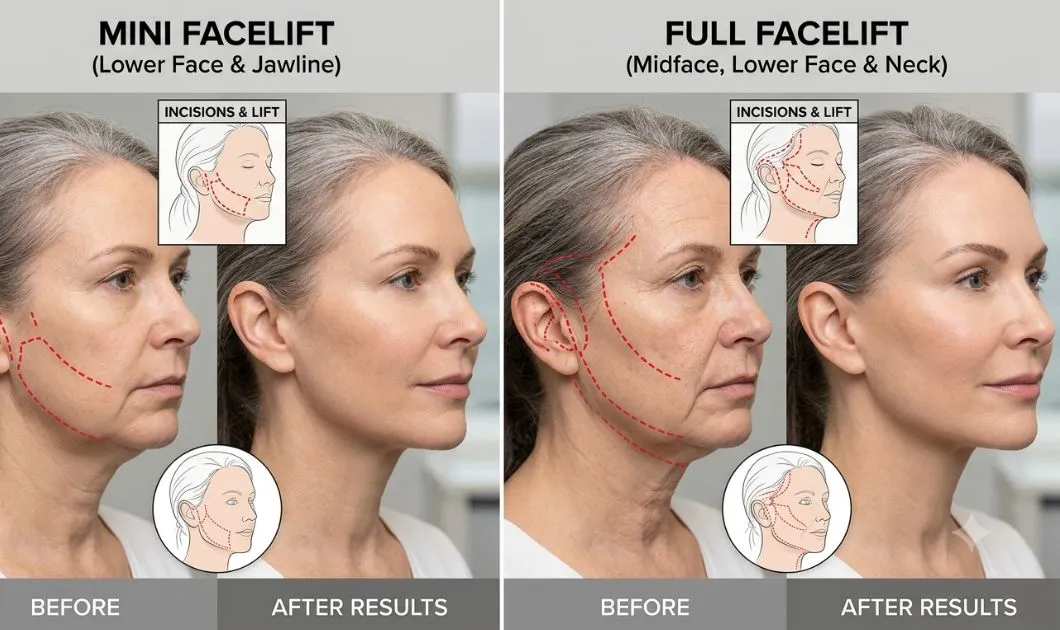
A mini facelift is essentially a less invasive form of facelift surgery. In particular, it targets early to moderate signs of facial aging, mainly around the lower cheeks and jawline.
- Treatment area: Lower face and upper jawline. Generally, it does not address the neck.
- Incisions: Shorter incisions, usually placed near the ear, which makes scars easier to conceal.
- Technique: The surgeon lifts and tightens the skin and underlying tissue, though with less repositioning than a full facelift.
- Recovery: Recovery is generally faster, often just one to two weeks before returning to normal activities.
- Benefits: A subtle, natural-looking improvement with less downtime.
- Ideal candidates: People in their late 30s to 50s with mild jowls, early sagging skin, or a softening jawline, but otherwise good overall skin elasticity.
In short, think of it as a targeted refresh rather than a full transformation.
What Is a Full Facelift?
By contrast, a full facelift Surgery Dubai , sometimes performed as a SMAS facelift or deep plane facelift, is a more comprehensive form of facial rejuvenation.
- Treatment areas: Mid-face, lower face, jowls, and often the neck.
- Technique: The surgeon works on the SMAS layer, the deeper muscular and connective tissue beneath the skin. As a result, this deep tissue lift repositions sagging structures rather than simply pulling the skin.
- Neck improvement: A full facelift frequently includes a neck lift or neck tightening, which addresses loose skin and muscle bands under the chin.
- Recovery: Longer recovery, generally two to three weeks before returning to social activities, with residual swelling settling over the following months.
- Results: More dramatic, longer-lasting results that address advanced aging across the whole lower face and neck.
- Ideal candidates: People with moderate to advanced aging, noticeable jowls, cheek sagging, and loose neck skin.
Mini Facelift vs Full Facelift: Comparison Table
| Factor | Mini Facelift | Full Facelift |
|---|---|---|
| Purpose | Subtle lift for early aging | Comprehensive facial rejuvenation |
| Best Age | Late 30s–50s | 50s and above |
| Ideal Candidate | Mild sagging, good skin elasticity | Moderate to advanced aging |
| Treatment Area | Lower face, jawline | Mid-face, lower face, neck |
| Incision Length | Shorter, near the ear | Longer, extends behind the ear/hairline |
| Recovery Time | 1–2 weeks | 2–3 weeks |
| Downtime | Minimal | Moderate |
| Results | Natural, subtle | Noticeable, dramatic |
| Longevity | 5–7 years on average | 8–10+ years on average |
| Scarring | Smaller, well-concealed | Longer, but well-hidden in natural creases |
| Anesthesia | Local with sedation, sometimes general | Usually general anesthesia |
| Procedure Time | 1.5–2.5 hours | 3–5 hours |
| Cost | Generally lower | Generally higher |
| Neck Included | Rarely | Often, or paired with neck lift |
| Natural Appearance | Very natural, subtle change | Natural when performed by an experienced surgeon |
| Maintenance | May need a touch-up sooner | Longer-lasting, less frequent maintenance |
Which Procedure Do You Actually Need?
Ultimately, there’s no universal answer here. Instead, the right choice depends on a few honest factors.
Signs You May Need a Mini Facelift
- Mild jowls or early jawline softening
- Good skin elasticity overall
- You want a quick recovery
- Your neck still looks relatively firm
Signs You May Need a Full Facelift
- Noticeable sagging skin across cheeks and jaw
- Visible neck laxity or banding
- You want longer-lasting results
- Previous mini facelift results have faded
Other Factors That Matter
Additionally, a few lifestyle and anatomical details often tip the decision:
- Lifestyle: Active professionals often prefer the shorter downtime of a mini facelift.
- Age: Younger patients with early aging tend to suit a mini facelift, whereas older patients with advanced aging often benefit more from a full facelift.
- Skin quality: Thicker, more elastic skin generally responds well to a mini facelift. Meanwhile, looser, thinner skin often needs the deeper support of a full facelift.
- Goals: A subtle refresh calls for one approach, while a complete facial contouring transformation calls for another.
Overall, a proper facelift consultation with a qualified surgeon remains the only reliable way to know which category you fall into.

Recovery Differences
Recovery is often the deciding factor for many patients, so here’s what to expect from each option.
Healing Timeline
Typically, mini facelift swelling peaks within 48 hours and fades within a week or two. Full facelift swelling, on the other hand, can take several weeks to fully resolve.
Bruising
Both procedures cause some bruising. That said, it’s typically more pronounced after a full facelift due to the deeper tissue work involved.
Returning to Work
Generally, many mini facelift patients return within 7–10 days, whereas full facelift patients often need two to three weeks.
Exercise
For both procedures, light walking is encouraged early on. However, strenuous exercise should wait four to six weeks regardless of which procedure you choose.
Sleeping Position
Similarly, sleeping with your head elevated helps reduce swelling after either surgery.
Scar Care
Finally, follow your surgeon’s instructions closely. In particular, keeping incisions clean and protected from sun exposure supports smoother healing.
Benefits of Each Procedure
Benefits of a Mini Facelift
- Shorter recovery time
- Smaller, well-hidden incisions
- Natural-looking, subtle refresh
- Lower cost compared to a full facelift
- Can be combined with non-surgical options for enhanced results
- Ideal for preventative treatment before aging progresses further
Benefits of a Full Facelift
- Addresses the neck as well as the face
- Longer-lasting results
- Corrects moderate to advanced sagging skin
- Improves jawline definition and facial harmony
- Provides a deeper, more structural lift through the SMAS layer
- Delivers comprehensive facial rejuvenation in a single procedure
Are There Any Risks?
Naturally, every surgical procedure carries some risk, and facelift surgery is no exception. That said, being informed helps you make a confident decision.
Possible risks include:
- Infection
- Bleeding or hematoma
- Temporary numbness or altered sensation
- Swelling and bruising beyond the expected timeline
- Delayed scar healing
- Asymmetry, in rare cases
Fortunately, choosing an experienced, board-certified facial plastic surgeon significantly reduces these risks. Therefore, always ask about your surgeon’s training, their experience with the specific technique, and before-and-after results from previous patients.
Mini Facelift vs Full Facelift Cost in Dubai
Overall, facelift cost in Dubai varies widely, and it isn’t something we can quote accurately without seeing you in person. Instead, several factors affect the final price:
- Surgeon experience and qualifications
- Facility and technology used
- Type of anesthesia required
- Complexity of the procedure, including whether a neck lift is combined
Because every face is different, an accurate quote can only come after a proper facelift consultation, where your surgeon assesses your skin, goals, and anatomy.
Why Choose Trusta Clinic?
In Trusta Clinic Dubai, patients work with experienced cosmetic surgeons who take a personalized approach to every treatment plan.
Specifically, we combine modern surgical techniques with a strong focus on patient safety, aiming for natural-looking results that respect your unique facial anatomy.
Every journey, therefore, begins with a comprehensive consultation, where you can ask questions, share your goals, and get honest guidance, whether that means a mini facelift, a full facelift, or a non-surgical alternative.
Conveniently located in Dubai, Trusta Clinic is built around clear communication and realistic expectations from the very first visit.
Frequently Asked Questions
What is the difference between a mini facelift and a full facelift?
A mini facelift targets the lower face and jawline through smaller incisions, offering subtle results with faster recovery. A full facelift, however, addresses the face and neck more comprehensively, using deeper tissue repositioning for longer-lasting results.
Is a mini facelift worth it?
For patients with early signs of aging and good skin elasticity, a mini facelift can offer excellent, natural-looking improvement with minimal downtime. That said, it’s not designed for advanced sagging or neck concerns.
Who is a good candidate for a mini facelift?
Generally, good candidates have mild jowls, early jawline softening, and healthy skin elasticity. Even so, a facelift consultation confirms candidacy based on your specific facial anatomy.
How long does a mini facelift last?
Typically, mini facelift results last five to seven years, depending on skin quality, lifestyle, and genetics.
How long does a full facelift last?
By comparison, full facelift results typically last eight to ten years or longer, since the technique addresses deeper facial structures.
Does a full facelift include the neck?
Often, yes. In fact, many full facelift procedures include neck tightening, or are paired with a dedicated neck lift for comprehensive results.
Which facelift has less downtime?
Overall, a mini facelift has shorter downtime, with most patients returning to normal activities within one to two weeks.
Can younger patients get a facelift?
Yes, some younger patients with early sagging skin choose a mini facelift as a preventative step, though candidacy always depends on individual assessment.
What age is best for a facelift?
There’s no fixed age. Instead, candidacy depends more on skin quality and degree of aging than age alone, though mini facelifts are common in the late 30s to 50s, while full facelifts are more common from the 50s onward.
Is a mini facelift permanent?
No facelift is permanent, since facial aging continues naturally. However, mini facelift results can last several years before any touch-up is needed.
What is recovery like after facelift surgery?
Generally, expect swelling and bruising in the first one to two weeks, gradually improving over the following weeks. Full recovery, including residual swelling, can take a few months.
How much does a facelift cost in Dubai?
Ultimately, facelift cost in Dubai depends on the technique, surgeon, and facility. Therefore, an accurate estimate requires a personalized consultation.
Conclusion
In the end, choosing between a mini facelift and a full facelift comes down to your skin, your goals, and how much change you’re looking for. A mini facelift offers a quicker, subtler refresh, while a full facelift provides a more complete, longer-lasting transformation, including the neck.
Neither option is better across the board only better for a specific set of needs. Therefore, the clearest path forward is a professional evaluation of your facial anatomy and aging pattern.
Book a consultation with Trusta Clinic to discover which facelift option best suits your facial anatomy and aesthetic goals.